Showing posts with label inaction. Show all posts

Thursday, March 15, 2007

FIRST DAY JITTERS

SLINEY, LEIDIG, MYERS: THREE DEFENSE LINKS SWAPPED AT THE LAST MINUTE
Adam Larson
Caustic Logic/They Let It Happen
January 1 2007
Last Update: 3/19


9/11 was just such a weird day, who could think it relevant that among the other oddities of that morning The FAA was being run by a first-day rookie? Benedict Sliney was just getting his feet wet as the National Operations Manager when four civilian airliners were hijacked amid confused reports of about a dozen possible hijacks. While Sliney had superiors like FAA administrator Jane Garvey, he was called on to make major decisions that morning. He told the 9/11 Commission: “NORAD […] asked ME if I were requesting military intervention. And I indicated to NORAD that I’m advising you of the facts of this particular incident – I’m not requesting anything. I wasn’t sure I even had the authority to request such a thing.” [1] Perhaps he hadn’t watched the training video closely enough the day before.

But was the Chain of Command he and the others at FAA informing any better organized? The National Military Command Center (NMCC), beneath the Pentagon, is the command and control “nerve center” for the military leadership if America comes under attack. While this usually does not happen, the NMCC sits ready, watched over and coordinated by the Deputy Director of Operations (DDO) and is used for other activities requiring centralized coordination – like passing on requests for fighter assistance in case of a hijacking and, I’d guess, coordinating air-based War games, of which there were at least five on 9/11.
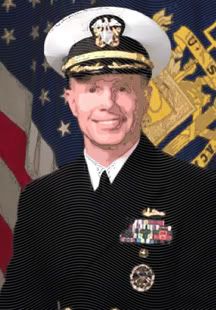
Then Captain Charles J. Leidig - acting NMCC Director for almost precisely the 90 minutes of the 9/11 attacks
Army Brigadier General Montague Winfield was originally slated to be in charge of the NMCC that morning, but the previous day he had decided to take some time off, asking a recently qualified but inexperienced rookie, Navy Captain Charles Leidig, to stand in as DDO in the morning. This is confirmed by Leidig’s own testimony to the 9/11 Commission. His written statement was the shortest they received at just over one page, large font, double spaced. It stated blandly “on 10 September 2001, Brigadier General Winfield, US Army, asked that I stand a portion of his duty […] on the following day. I agreed and relieved Brigadier General Winfield at 0830 on 11 September 2001.” [2] At that very minute, the first plane was right between its hijacking (about 8:15) and its impact with the WTC (8:46).

The remarkable request was presumably for some other, lesser, reason. But Leidig’s rookie status (only qualified to be DDO a few weeks earlier) and the emerging crisis did not interrupt the transfer and Winfield left. I can’t say whether this had any operational role in 9/11 or the lack of defense against it, or was related to the air-based war games that have been acknowledged, but both seem probable. And while certainly the timing of this admitted September 10 request is beyond coincidence, none of the involved parties have offered any explanation - it has remained both curiously open and unexplained.

But war games or no, Leidig’s job there wound up more than a drill. As the 9-11 Commission’s final report explained “the job of the NMCC in such an emergency is to gather the relevant parties and establish the chain of command between the national command authority […] and those who need to carry out their orders.” [3] This includes, among others, the Defense Secretary and JCS Chairman. Acting Joint Chiefs Chairman, Air Force General Richard Myers – like Leidig, filling in as of the morning of 9/11 – claims total ignorance of the attack until about 9:40, and the 9/11 Commission confirmed that he arrived at the NMCC and joined the conference in session just before 10:00, over an hour after the attack began and just as it was ending.

By the time Myers arrived at 10:00, regular DDO Montague Winfield had taken the center over again from Leidig, but Rumsfeld, the middle link in the “national command authority” chain Leidig was tasked with “gathering,” was still MIA. Winfield would later state “for 30 minutes we couldn't find him. And just as we began to worry, he walked into the door” at 10:30 – nearly a half hour after the attack was over. [4] While he’d been at the building all morning, officially he’d been too busy loading injured into ambulances for the TV cameras to take his part in the defense, though accounts of his whereabouts vary greatly.


So here is the graphic representation of Leidig’s unorthodox stand-in shift and the results of his work to “gather the relevant parties” during the 111 minutes that hijacked attack craft were attacking the heart of America’s financial and military might. By whatever confluence of factors, the room was kept vacant of upper leadership until Leidig relenquished control and the attack ended. We should be left wondering why the parties weren’t gathered, what was so special about Leidig that he had to be there to fail to gather them, and who knew the day before just how badly he would fail when inserted in the morning?

Leidig did try to do things on his own as Myers and Rumsfeld kept their distance, initiating a phone bridge and significant event conference at 9:29, a line that the 9/11 Commission clarified did not have FAA on it. One minute later, Leidig announced that he was just told American 11 was still airborne. [5] It was also precisely at 9:30 that the Langley fighter pilots finally took off, and so Leidig gave them this new ghost target, which wound up distracting them from the very real Flight 77 as it closed in on his own location and entered radar screens again. The fighter pilots were never informed of the attack plane until after they saw smoke rising from the Pentagon after 9:37. The Commission admitted the FAA was not on the line with Leidig, but blames them anyway: “we have not been able to identify the source of this mistaken FAA information,” and left it at that [emphasis mine]. [6]

Since that day, Leidig has been promoted – first to Commandant of Midshipmen in September 2003, then to U.S. Defense Representative to the Pacific micro-states. Later he assumed command of U.S. Naval Forces Marianas and Navy Region Marianas and advanced to Rear Admiral status. Leidig is recipient of numerous service medals over his distinguished career, none specifically for his service on 9/11, of which his official Navy bio makes no mention whatsoever. [7]

[After I posted this, it occured to me to state I'm not accusing Adm Leidig of anything in particular, nor Sliney, Myers, or even Rumsfeld individually. I only present this in the public interest to help clarify the record - nothing personal.]

Sources:
[1] National Commission on Terrorist Attacks Upon the United States. Panel one, Day two of 12th public hearing. Staff statements on the military and civilian aviation authorities. Washington D.C. June 17, 2004. http://govinfo.library.unt.edu/911/archive/hearing12/9-11Commission_Hearing_2001-06-17.htm
[2] Flocco, Tom. "NMCC ops director asked substitute on 9-10 to stand his watch on 9-11.” Prison Planet. June 18 2004. http://www.prisonplanet.com/articles/june2004/061804askedsubstitute.htm
[3] 9/11 Commission Final Report. Page 37.
[4] Thompson, Paul and the Center for Cooperative Research. “The Terror Timeline.” New York. Regan Books. 2004. Page 456.
[5] 9/11 Commission Final Report. Page 37.
[6] 9/11 Commission Final Report. Page 26
[7] Commander Naval Forces Marianas: Rear Admiral Charles J. Leidig. US Navy bio. http://www.guam.navy.mil/bio_adm.htm

Sunday, January 21, 2007

"THERE'S ONE TERRIBLE PILOT"

THE PRESIDENT STUMBLES INTO 9/11
Adam Larson
Caustic Logic/They Let it Happen
December 12 2006


One gaping hole in Bush’s account of his long dance with responsibility on 9/11 is how he first learned of the attack in New York and what he thought about it. Numerous people in the motorcade heading to the school before 9:00 were alerted to the first crash, and several eyewitness accounts have Bush informed before or shortly after arriving at the school that an airplane, probably a small private plane, had hit the World Trade Center. Bush himself has admitted to being informed by Andy Card, Carl Rove, and Condoleezza Rice; one report has the president musing in response that maybe the pilot had a heart attack, another that maybe it was bad weather. In all, Alan Wood and Paul Thompson at the Center for Cooperative Research counted six different stories of people informing him of this first plane’s crash. [1]

But Bush also has a seventh version, and it’s perhaps the most fascinating. On at least two occasions, Bush implied that he first heard of the crash from a TV left on in the hallway he was wandering before entering Miss Daniels’ room. At right around 9:00, a couple of minutes before the second plane hit, Bush said he “saw an airplane hit the tower” on the TV news. [2] But this is highly unlikely, as no footage of this event was aired until CNN obtained a video copy of the impact from a French camera crew that evening. Perhaps he meant to say he saw “the first plane had hit the tower,” and he was watching the smoking aftermath, which we all saw. But he repeated and clarified the story on January 5th, 2002; “when we walked into the classroom, I had seen this plane fly into the first building. There was a TV set on.” [3]

To my knowledge, no other government officials have backed this up – apparently the president had wandered off on his own at this point. These incongruous stories are certainly a curious window onto the President’s psychology. Everyone remembers where they were on 9/11, so why are his memories so strange and so obviously untrue?

Either way, the clincher is when he later recalled his thought process upon learning of the first plane to a Florida third grader named Jordan:“I used to fly myself, and I said, "There's one terrible pilot." And I said, "It must have been a horrible accident. But I was whisked off there - I didn't have much time to think about it." [4]

Let’s check the reasoning behind this conclusion, comparing it to Bush’s own experiences in the previous two months. In late July, Bush himself had been sleeping, dreaming peacefully of Crawford while floating on an aircraft carrier in Italy when he attended the 2001 G8 Summit in Genoa. This accommodation replaced the standard posh hotel on order of the Secret Service after warnings were received of a suicide hijacking threat (the crashing a plane into a building kind) against the collection of world leaders. According to the Los Angeles Times, Italian authorities closed the airspace over the venue and set up anti-aircraft guns, though the Summit continued with no incident. [5]

About two weeks later, after returning to Washington and then departing for a vacation in Crawford to dream of Genoa, Bush was informed of some kind of hijacking threat in the U.S. This was in his famous August 6th daily CIA briefing, entitled “Bin Laden determined to strike in U.S.,” which Bush later clarified he asked for in response to the Genoa affair. It stated that “FBI information […] indicates patterns of suspicious activity in this country consistent with preparations for hijackings or other types of attacks, including recent surveillance of federal buildings in New York.” [6] Traditional hijackings, it should be noted, do not really require any preparations, nor do they involve federal buildings on the ground. If by preparation they meant flight training, and if the building scoping was related to the air threat, the message should have been clear – suicide hijackings to bomb targets on the ground, as had been threatened at Genoa. It's not clear if this was clearly conveyed to the President at the briefing.

So in Bush’s mind, then:
Two-moth old threat of suicide hijacking (where a plane flies into a building)
+ One month old warning of possible “attack” involving a hijacking and/or New York buildings
+ A plane actually flying into a New York building known to attract terrorist attacks
= “Horrible accident… Terrible pilot.”

Is this chain of logic believable, even from George W. Bush? A year later, he still held to his story. He told 60 Minutes in an anniversary interview “I thought it was an accident. I thought it was a pilot error. I thought that some foolish soul had gotten lost and - and made a terrible mistake.” [7] “I was concerned about it, but there were no alarm bells,” he said elsewhere. And so, his services not required to deal with freak accidents, he calmly entered Miss Daniels’ room and surrendered to the power of story time at about 9:03, just as the second plane hit the WTC’s south tower.


Of course he learned a bare three minutes later that it was indeed terrorism and they were officially two-for-two, yet he failed to act decisively. I'm not terribly concerned with the five-to-seven minute Pet Goat episode, though the Booker Video is gripping. the problem for me is the next 55 minutes. Everybody who's broached the subject agrees that the only way the hijacked planes could have been stopped so late was by shooting them down and only the President could authorize that. By the official account anyway, he did not issue this authorization until about 10:05 or even as late as 10:18 - an hour or more after Andy Card's famous whisper and just as it became clear that the last plane had crashed.

But someone kept all the fighters well away from the targets anyway so Bush's serious dereliction of duty never became an issue. And once those planes completed their work unhindered, as Bush concluded to little Jordan, “when I got all the facts that we were under attack, there would be hell to pay for attacking America.” [8] And he should know, as the self-appointed collecter of payments on "hell's" behalf.

Sources:
[1]
An Interesting Day: President Bush's Movements and Actions on 9/11 By Allan Wood, Paul Thompson. Center for Cooperative Research.
[2] Bush, George W. “President Meets with Displaced Workers in Town Hall Meeting” Orlando, FL.
White House Press Release. December 4, 2001.
[3] Bush, George W. “President Holds Town Hall Forum on Economy in California.” Ontario, Calif.
White House Press Release. January 5, 2002.
[4] See [2]. Orlando.
[5]
“Italy Tells of Threat at Genoa Summit” Los Angeles Times. September 27, 2001.
[6]
[partial] “Transcript: Bin Laden determined to strike in U.S.” CNN. April 10, 2004.
[7]
“Bush Talks about the Moments of 9-11 as they unfolded for him.” CBS News. September 12, 2002.
[8] See [2]. Orlando.