Showing posts with label Mohammed KS. Show all posts

Tuesday, June 5, 2007

THE BOJINKA COVER STORY {masterlist}

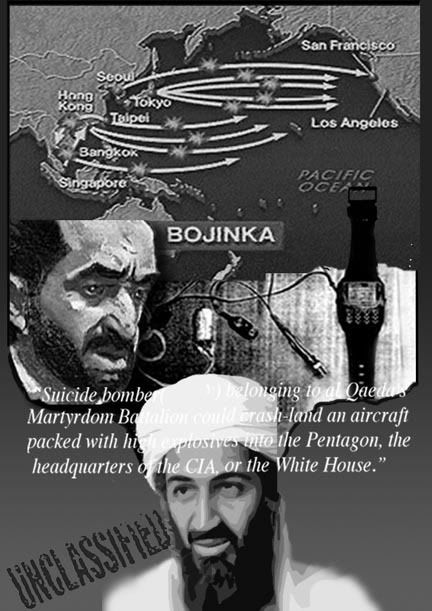
This is to link the few posts that will collectively explain a disturbing possibility that the US government essentially scripted out the 9/11 attacks nearly seven years before, planted the idea into the early body of knowledge about the terrorists later to be called al Qaeda, and then reported as a precedent once a similar attack was carried out on 9/11. The plan was again recycled, this time exactly, as the London terror threat of 2006 that banned all liquids from flights after fears of a ten-plane attack using liquid bombs - precisely the idea behind the original "Operation Bojinka," uncovered in early 1995.

Admittedly, this is a bit off the Let it Happen tangent of the blog here as a whole, integrating best with a MIHOP interpretation. But I'm not sure where else to put it, and I'm already covering the hijackers here, so here it goes.

Bojinka intro: From the "cover story" chapter IV of my book "Scenario 12-E: The Philosophy, the Technology, and the Cover Story Behind Shadow 9/11."

----
The Perfect Story
Now we have clarified that at the flip of a few switches, it would be technically possible for otherwise ordinary commercial flights to be turned into flying tombs, sealed off from the outside world and locked into their final flight plan by people who would be sitting safely somewhere else, perhaps sipping lukewarm coffee. But what would the eyewitnesses say?

What was needed was the tactic, the fingerprint, to mask the operation and steer the blame in the desired direction. The cover story was already well-developed in advance, not by a government agency or think-tank, but by the natural flow of world events (or at least by some collaborative effort between the two). And the direction of the blame was towards Eurasia and the one enemy in particular who was safely camping out in the heart of that central continent – Afghanistan.

To all eyewitness accounts, Shadow 9/11 would appear like a bin Laden attack, fitting with preconceptions. Ah, the preconceptions… The writers of that Lone Gunmen pilot, as they scratched it out in 2000, had to wonder “if I were a right-wing-faction-type, and I wanted to convince people we’d been attacked by a “tin pot dictator” how would I do it?” When we disregard the PC bias on TV that filters out racial references, it’s pretty clear this would be an Arab dictator, probably bin Laden, maybe supported by Saddam Hussein. What did these sci-fi writers decide? Apparently the same thing the planners of Shadow 9/11 decided.

The cover stories for both Scenario 12-D and for Shadow 9/11 may have been lifted straight from al Qaeda’s famous Operation Bojinka, an early airliner-centered terrorist plot discovered in the former U.S. colony of the Philippines in early 1995. In an interview after the attacks, Khalid Shaikh Mohammed claimed that the 9-11 attacks he allegedly financed were a revived and streamlined version of this six year old plot. Like no other single story, this one looks like the taproot of September 11’s infamous tactic. But the exact degree of foresight, what was known by whom, is a matter of great contention, and the factual record is left fragmented. There are weird forces at work here.

- Bojinka I:Phase One: A Loud Bang in Manila Ramzi Yousef, a chance explosion, a pope spared, and the origins of the plot in the Philippines, early 1995.

- Bojinka II:Phase Two: The Evolution How Bojinks DIDN'T lead to a prediction of the 9/11 tactic - simultaneous suicide hijackings - even though it clearly should have.

- Bojinka III:Before Bojinka: Corder, the GIA, and Cetron’s Scenario The Pentagon report that laid out the Bojinka threat just days before it was discovered in terrorist minds.

- Bojinka IV:A Real and Repeated Threat Before 9/11, suicide hijackings were actually real and didn't need to be imagined. The only thing different about 9/11 is this one wasn't stopped.

- Bojinka V: Florida 2001: Bojinka Becomes 9/11?

- Bojinka VI: Brzezinski's Bombshell/What Was Left Out: A prominent article on bojinka by Zbigniew Brzezinski's nephew, and the general deletion or minimization of the suicide airliner hijacking element.

- Bojinka VII: Professed Ignorance, Maintaining the Focus "I don't think anyone could have predicted..."

- Bojinka VIII: Operation Brzezinski? the Brzezinski article and the word "Bojinka" get me thinking to a bizarre and probably useless observation that still gives me a chill and I thought it worth sharing. (coming soon)
--------- -----------

Friday, January 5, 2007

BOJINKA VIII: OPERATION BRZEZINSKI

Adam Larson
Caustic Logic/They Let It Happen
Written late 2005
Posted 1/20/07


As he was asked repeatedly in his Q and A session, "Bust and Boom" author Matthew Brzezinski is indeed the nephew of Zbigniew Brzezinski, the Polish-born former National Security Adviser to President Jimmy Carter. A cold and calculating thinker who has been described as the Democrats’ Henry Kissinger, the elder Brzezinski has tried his hand at non-fiction, writing many books, including his 1997 The Grand Chessboard: American Primacy and its Geo-Strategic Imperatives. In this book he noted, among other things, the strategic role of securing Afghanistan (as well as Ukraine, Azerbaijan, and - surprise - Poland) in relation to the American empire to hedge in Russia or any other rival to control of the “Grand Chessboard” of Eurasia.

Zbig’s own earlier role in Afghanistan was pivotal, encouraging and provoking the Soviet invasion of December 1979 that triggered the Jihad where bin Laden and the other future al Qaeda leaders met and learned the tools of the terror trade. This was a conscious plan of Brzezinski’s to give the USSR “its Vietnam War” to “make the Soviets bleed for as much, as long as possible” but with no American deaths. [1] President Carter agreed, approved funding, and sent Zbig to Islamabad in January 1980 to show support for Pakistan’s resistance against the Soviet occupation. He took a little side-trip to the Afghan border to rally the international coalition of radical Islamists; dressed in a parka at the Khyber Pass, Zbig told them “your fight will prevail because your cause is right and God is on your side.” [2]

Whatever works at the time works, including dirty tricks like creating terrorist networks; but Zbig continued to boast of this as “an excellent idea” even as late as an early 1998 interview in which he asked his interviewer “what is more important in world history, the Taliban or the collapse of the Soviet Empire? Some agitated Muslims or the liberation of Central Europe and the end of the Cold War?” [2] At the time it may have seemed a toss-up, but later that year two US embassies blew up in Africa and bin Laden declared holy war on the US – his crusade started taking on its eventually convincing global dimensions as a replacement for the Soviet threat.

Zbig’s son Ian Brzezinski is now helping the Pentagon keep Central Europe “liberated” from Russian domination as Deputy Assistant Secretary of Defense for European and NATO Affairs, appointed shortly after 9/11, in November 2001. Ian is at virtually every Pentagon meeting where European diplomats are present, usually seated right next to the top U.S. official. A longtime NATO insider, he spearheaded the effort to shape its expansion into Latvia, Lithuania, Estonia, Bulgaria, Romania, Slovakia and Slovenia. All seven “North Atlantic” states were approved for membership in March 2004, followed by Brzezinski’s capstone article “An Alliance Transforming.” [4] His advising record and his catalog of writings indicates that Ukraine, once the second most powerful Soviet Republic, is the final prize in this campaign, a play right out his dad’s 1997 book!

Ian's brother Mark Brzezinski has also helped in this process, as a possible Secretary of State if John Kerry had won in 2004, and otherwise devoted to the “Democratic transformations” wracking the former Soviet Space in the early years of this “new American Century” - notably the dioxin-induced Orange Revolution that turned Ukraine, of all places, upside down.

Ian’s and Mark’s sister Mika Brzezinski had worked as a reporter and host for CBS News for a few years until 2000, when she went over to MSNBC for a bit. Her return to CBS in early September 2001 was rewarded with the post of top New York correspondent. She was already reporting from the WTC before the second plane hit, and continued throughout the weeks after, anchoring millions of viewers to the latest from Ground Zero from the first moments of shock and awe through the early and raw phase of the “War on Terror” mentality. [5] Thus her timely return allowed her to have no small role in shaping the “widely perceived” part of what her father had four years earlier called the “direct external threat” that would allow “imperial mobilization.” [6] She later vied for an anchor slot on the back of such notable reportage, but lost the bid to Katie Kouric.

And then there’s nephew Matthew’s article that claims to expose the roots of al Qaeda’s sinister plan that led to all this. Some, like Matt, explain that the name Bojinka is a Serbo-Croatian slang word for “loud bang.” Some sources interpret it as meaning “chaos in the sky” or something to that effect. Khalid Shaikh Mohammed, the suspected financier of both this plan and September 11, explained in a 2003 interview that Bojinka is simply a nonsense word he picked up in the international bazaar that was the Afghan Jihad. [7]

Maybe this is coincidence, but I think it also sounds a little like “Brzezinski” (pronounced Brr-jhin-skee). If I let my imagination run for a minute, and I will, I can visualize “Bojinka” starting out as a nonsense nickname Osama gave Zbigniew when they met in Pakistan in 1980. They were both in country at the same rough time and for the same reason. As we’ve seen, Brzezinski visited the bustling Khyber Pass on a side-trip from his mission to Pakistan in January. Meanwhile, the Soviet invasion had made Osama “furious,” as he later recalled, and he was far from alone. As one of many sons from the Saudi Kingdom’s second richest family, he was the top export they had at the time. He first arrived at Peshawar, near the Khyber Pass, within weeks of the invasion - January. [8]

He and Brzezinski were both there to boost the funding and the morale of the frontline troops and to show the unity of purpose in the anti-Soviet alliance: Pakistan, Saudi Arabia, Israel, the U.K., and the U.S. Thus as the top representatives of their respective allied nations, it would in fact be a bit odd if the two men hadn’t met. It is a hard name to pronounce. “Ah, here he is now, our American friend Mr. Buruz… zuzzuz.. Mr. Baarrjjuzzz… Mr. Bojinka!” (big hearty laughs all around, it evolves among the Muj into a little frontline joke, one thing leads to another…) Both men would, and have, denied such meetings; bin Laden claims he never knew he was serving America’s interests at all. But it’s an intriguing thought, and vaguely possible. Weird things abound, I’ve found, around this weird name.

Sources:
[1], [2] CNN. Cold War Experience. Episode 20. Soldiers of God. Accessed November 9, 2005 at: http://www.cnn.com/SPECIALS/cold.war/episodes/20/script.html
[3] Interview with Zbigniew Brzezinski, President Jimmy Carter's National Security Adviser Le Nouvel Observateur, Paris, 15-21 January 1998 Posted at globalresearch.ca 15 October 2001http://www.globalresearch.ca/articles/BRZ110A.html
[4] U.S. Foreign Policy Agenda. Volume 9, Number 2. June 2004. (CIAO Date 9/04 - ?) Accessed November 10, 2005 at: http://www.ciaonet.org/olj/fpa/fpa_jun04/
[5] Mika Brzezinski profile. CBS News. Copyright 2002. Accessed November 9, 2005 at: http://www.cbsnews.com/stories/2002/10/28/broadcasts/main527208.shtml
[6] Brzezinski, Zbigniew. The Grand Chessboard: American Primacy and its Geostrategic Imperatives. New York. Basic Books. 1997. Pages 210-211
[7] 9/11 Commission Final Report. p 488-489
[8] Frontline: “A Biography of Osama Bin Laden.” PBS. 2001. http://www.pbs.org/wgbh/pages/frontline/shows/binladen/who/bio.html

Wednesday, November 29, 2006

BOJINKA I: A LOUD BANG IN MANILA

As the official story goes, while Pope John Paul II was preparing to visit Manila in early 1995, with security ratcheting up everywhere, two early al Qaeda masterminds were mapping out his route. They were preparing to dress in ecclesiastical garb and blend in to the procession with bombs beneath their robes, and even collected pictures of the pontiff to ensure they would kill the right guy. The 9-11 Commission concluded they also plotted to assassinate President Clinton there in November, but missed their chance. [1] They were staying in a hotel (Dona Josefa Apartments, room 603) only 200 yards from the Vatican embassy, and almost as close to the local police station. They moved in on December 8, 1994. They had few visitors over the next month, but one, Khalid Sheikh Mohammed (KSM), was reportedly financing their operation and was in and out of room 603.

Yousef and Murad also built a lot of bombs, one of which blew up prematurely on January 6. The two men fled their burning room, explaining they’d had a mishap with fireworks and would be back soon. Later on one of the culprits made good on his promise and was arrested by local authorities as he returned to the smoking scene. The suspect was quickly identified as Abdul Murad, an al Qaeda-linked Kuwaiti trained and licensed to fly commercial airliners in U.S. flight schools, and wanted in connection with the 1993 WTC attack. Ramzi Yousef, suspected mastermind of that attack, was the other guy in room 603, and returned with Murad. But when he saw the police, he fled, and evaded capture for a bit longer.

But Yousef did leave behind his lap-top computer and some disks, apparently too heavy to take with him as he fled. Of course they were full of top secret terrorist information. Investigators found an apparent mess of data on this computer – flight numbers, Arabic-sounding code-names, references to timers, all under the heading “Bojinka.” Yousef in fact had allegedly executed a test-run just weeks before, planting a small practice bomb beneath his seat. It worked, killing a Japanese businessman on the next leg of the plane’s flight and injuring others, forcing an emergency landing. [2]

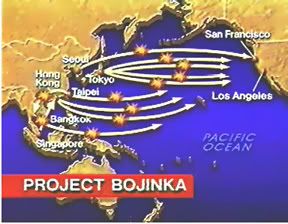
Bojinka_CNN
A Graphic Used by CNN in their original reporting in 1995-96.
Bojinka was soon discovered to be the itinerary for eleven terrorists to plant eleven nitroglycerine bombs, much more powerful than the test bomb, on eleven U.S. jetliners, timed to explode simultaneously over the Pacific. And it was set up to go, possibly soon. White House Counter-terrorism “Czar” Richard Clarke mentioned Bojinka in his book Against All Enemies, by details if not by name. He wrote how he received a message from Manila regarding Ramzi Yousef and his devious plan, which featured undetectable liquid bombs to be assembled in eye drop bottles on board the planes. The bombers were then to mimic Yousef’s trial run and disembark, leaving the others to die. Clarke called the FAA and told them to stop all flights originating in the Pacific. When flights resumed, liquids were not allowed on board. [3] Officials later estimated 4,000 people would likely have died if the plot hadn’t been intercepted. Vincent Cannistraro, former CIA counter-terrorism director later said of this plan “we had never seen anything that complicated or ambitious before. It was unparalleled.” [4]

Within a few weeks of Bojinka’s discovery, Yousef was rounded up in Pakistan and joined Murad in prison. According to Peter Lance, that wacky KSM happened to be living in the same building, and when he saw reporters from Time show up, he told them all about the arrest with his own face but the clever pseudonym “Khalid Sheikh.” [5] The next day Yousef was flown to the U.S. and helicoptered to jail in Manhattan. An FBI agent reportedly shouted to him over the noise “you see the Trade Centers down there, they're still standing, aren't they?” Yousef allegedly responded “they wouldn't be if I had enough money and enough explosives.” [6]

Yousef and Murad were joined in the conspiracy charge by an Afghan named Wali Khan Amin Shah. CNN reported on the Bojinka trial in mid-1996, starting with jury selection on May 13. [7] Ramzi knew his rights, and chose to represent himself. His co-defendants Murad and Shah retained a defense team that called five witnesses, as CNN reported, “including a police officer from the Philippines who admitted that he had mixed up evidence he had examined.” Yousef maintained he’d been framed by Philippines police, but the three were finally convicted on all counts of attempted murder and related charges on September 5. The charges carried out a mandatory life sentence at least, with the sentencing scheduled for December 5. [8] Case closed… Long silence...

Sources:
[1] 9-11 Commission Final Report. Page 147.
[2] “Oplan Bojinka.” Wikipedia. Accessed November 11, 2005 at: http://en.wikipedia.org/wiki/Bojinka
[3] Clarke, Richard. “Against all Enemies.” 2004. Pages 93-94.
[4] Brzezinski, Matthew. “Bust and Boom: Six years before the September 11 attacks, Philippine police took down an al Qaeda cell that had been plotting, among other things, to fly explosives-laden planes into the Pentagon.”
Washington Post. December 30 2001. Page W09 http://www.washingtonpost.com/ac2/wp-dyn/A14725-2001Dec21?language=printer
[5] Lance Page 328, cited from Paul Thompson and the Center for Cooperative Research, the Terror Timeline, 2004, Page 14
[6] Paul Thompson and the Center for Cooperative Research, the Terror Timeline, 2004, Page 14
[7] CNN. “Terrorism trial begins in New York.” May 13, 1996. Accessed November 10, 2005 at: http://www.cnn.com/US/9605/12/terror.plot/
[8] CNN. “Plane Terror Suspects Convicted on all Counts.” September 5, 1996. Acc. Nov. 9, 2005 at: http://www.cnn.com/US/9609/05/terror.plot/index.html