Showing posts with label Flight 175. Show all posts

Thursday, March 22, 2007

FAA IV: SLINEY'S AUTHORITY, UNLIMITED YET UNSURE

Ben Sliney’s Odd Initiation
Adam Larson
Caustic Logic / They Let It Happen
March 22 2007
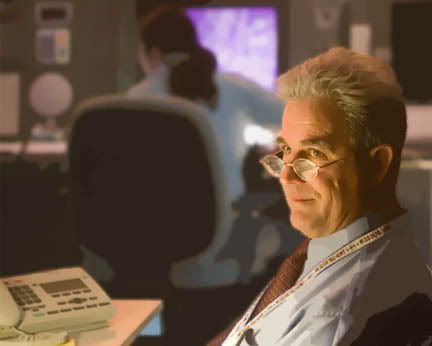

Benedict Sliney, on the set of “Flight 93,” (2006), reliving his high-pressure first day as FAA national operations manager

Besides the NMCC and Joint Chiefs of Staff, the Federal Aviation Administration, through whose system the 9/11 attacks occurred, was in weird hands on that weird day. Benedict Sliney had experience with FAA air traffic control dating back to 1964, but from the early 1980s took an 18-year hiatus to practice law in Manhattan. [1] He made a name for himself defending NY’s transit authority against passenger lawsuits, and once suing the FAA on behalf of fellow air traffic controllers. He gave up law in mid-2001, which he surrendered only, he says, after his 72-year-old secretary unexpectedly retired.

“I could not work without her, […] I wasn't going to continue. I didn't like law anyhow, it paid well, but it's very demanding in terms of time. I maintained my friendship of course with people in the FAA. The person in charge of the command center asked me, when I would complain about the law to come back to the FAA and I did.” [2]

This was apparently in mid-2001 when some combination of FAA connections, leadership skills, whatever, gave him a sudden career change back to the Administration, and straight to the top: National Operations Manager, a short, powerfully titled post described by USA Today as “the chess master of the air traffic system.” The paper explained “when he accepted the job overseeing the nation's airspace a few months earlier, Sliney wanted to be sure he had the power to do the job as he saw fit. "What is the limit of my authority?" he asked the man who had promoted him. "Unlimited," he was told.” [3] He got the job, and over the next several weeks set to re-learning the ropes and the two decades of technological and procedural changes since his old days.

It was hoped he’d learn enough to fulfill his normal, routine, functions. But Sliney’s new job also made him the man who would, theoretically, be responsible for such unprecedented things as ordering nationwide ground-stop of all air traffic, not that it ever had been an issue before. And he would also be the very guy in charge of requesting fighter assistance in the event of a suicide hijacking, on the off-chance that should ever be needed, which also had never ever happened once in the US. So perhaps understandably, these more esoteric duties were seemingly passed over a bit.

Tuesday being the slowest air travel day, little was expected (?) as Sliney clocked in for his first day at the FAA national operations center in Herndon Virginia, smack between Dulles Airport, the capital, and the Pentagon, at some time before 8:00 am on September 11. But it didn’t stay quiet for long; “It was a very short time,” Sliney later remembered, before he received the first clue this day would not be routine. At about 8:25 am, one of his assistant informed him “that they had an admission that a flight attendant was stabbed. Now it's starting to take a road that we hadn't been down before. It swiftly escalated after that.” [4] Somewhat less swiftly, the FAA response to the unfolding attack, largely overseen by Sliney, was measured, graduated:

8:15-20ish – Numerous calls sent to FAA from flight attendants Ong and Sweeney onboard Flight 11, clearly telling of a hijacking in progress.

8:24 - a transmission intended for the passengers on Flight 11 but accidentally sent system-wide by the hijackers, was received: "We have some planes. Just stay quiet and you will be OK." After Sliney learned of this line, USA Today reported, “the words will haunt him all morning. "We have some planes." Some? How many?” [5]

Before 8:46 – Sliney later described “an unidentified aircraft,” that is, with no transponder, “at 16,000 feet approaching New York City from the northwest at a pretty moderate ground speed of 300 knots. No one was working and we did not know who the aircraft was.” [6] Without transponders, we're told, it was hard to tell one of the thousands of blips from the next (which, if true, made the system completely useless)

8:46-8:50 - Sliney receives word from New York of a “small plane” crash into the World Trade Center. They turn on CNN in the control center. “That was no small plane, Sliney thinks.” Within minutes his suspicions were confirmed: it was the missing AA11. [7]

9:03 – The second plane, UA175, hits the second tower, and New York’s air space is ordered shut down, a multi-state area cleared of air traffic in the first such unprecedented move of the morning. Realizing this is an attack, and twenty minutes into it, Sliney scrambles to make up for lost time. It was time for bold – but not hasty - action.

9:15 – American Airlines orders no more AA takeoffs in the northeast. No concrete moves from Sliney in Herndon yet, just listing all troubled, possibly hijacked flights on a dry erase board. “The moves aren't strong enough for some of the air traffic specialists at the center,” says USA Today, “who bombard Sliney with advice. "Just stop everything! Just stop it!" The words ring true to Sliney.” [8] Haunted by knowledge of more planes, Sliney responds. Seconds tick by. (one mississippi, two mississippi, three mississippi... ten more minutes pass)

9:25 - AA77 has now been unaccounted for as well, for thirty minutes. Sliney issues another unprecedented order: full groundstop. No FAA controlled flights are to take off, anywhere in the country. The skies are full enough, but it wasn't yet time to order them cleared altogether.

“Amid the shouts and chatter and conflicting reports,” USA Today reported, Sliney “reminds himself: Don't jump to conclusions. Sort it out.” Indeed, deliberation seems his strong point: “since the second Trade Center tower was hit, Sliney has considered bringing every flight down,” the paper reported. It wasn’t until after the Pentagon was hit with AA77 at 9:38 that “the manager in charge of the nation's air traffic system is certain. He has no time to consult with FAA officials in Washington,” and made his snap decision all on his own to have all air traffic get out of the sky ASAP. "Order everyone to land! Regardless of destination!" Sliney shouted, since shouting helps orders get back in time to when they might have done some good. [1] The 9/11 Commission agreed that Sliney “ordered all FAA facilities to instruct all aircraft to land at the nearest airport” at exactly 9:42, 56 minutes after the first strike of the war against his native New York, an hour and twenty minutes after the first hijacking was known of.

Is that slow or fast? There’s not much precedence to judge by, but a faster response is at least feasible, by Sliney’s own account. US News reported in June 2004 that “he says he would have stopped everyone sooner,” had he not been left out of the pre-9/11 terror warning loop. Ominous predictions that had been issued that summer about al Qaeda’s potential air designs “never reached key people like Benedict Sliney.” [10] Whoever preceded Sliney in the NOM position likely had been aware of the threat, considering for example, the August 2001 CIA memo "Islamic Extremist Learns to Fly," and the high-level meeting Richard Clarke called on July 5, including FAA, and warning “something really spectacular is going to happen here, and it’s going to happen soon.” But the manager who might’ve known the score on what to expect, and probably had a better understanding of what could be done in response, was just not working out. And his replacement, being a first-day rookie not clued into the earlier threat assessments, was in effect a blank spacer inserted, by chance we are to believe, into a key spot in the air defense system.

Sliney was not the top link at FAA, of course. He had superiors like FAA administrator Jane Garvey and her deputy Monte Belger, and running all the way up to Transportation Secretary Norman “fuck pilot discretion” Mineta, in the PEOC beneath the White House with Cheney and Rice. But Sliney was the top hands-on guy with radar screens in front of him, called on to make major decisions that morning beside the ground stop. He told the 9/11 Commission about his first call with NORAD, at some point before 8:46:

“NORAD […] asked me if I were requesting a military intervention. And I indicated to NORAD that I'm advising you of the - of the facts of this particular incident. I'm not requesting anything. I wasn't sure I even had the authority to request such a thing. And when the lady persisted at NORAD, I asked her if I could call her back and I went to the domestic event net, which is available to all facilities and most of the major facilities around it, and I queried NORAD and the FAA headquarters as to whether or not I had such authority to ask for intervention by the military or a scramble on this particular aircraft, and they did agree that I had such authority after a discussion on the virtues of collaboration. However, I indicated further when I agreed that we should collaborate on such decisions, but if time did not permit it, did I have that authority, I persisted in that and they said that I did. I didn't know that prior to that moment in time.” [11]

CNN’s Paula Zahn explained further “Mr. Sliney says these conversations took several minutes and by the time he received an answer, the aircraft was past Manhattan,” meaning, I presume, past gone into the WTC. [12] Sliney had unlimited authority but like Bullwinkle the moose, he didn’t know his own strength, at least not precisely enough to do much of use on 9/11. He learned his powers eventually, of course, but too late. I’m not sure how long after 9/11 he held the NOM job, but by the time of his candid and well-covered May 2004 testimony to the 9/11 Commission, he had switched over to Operations Manager for the New York Terminal Radar Approach Control, another slot that had been vital on 9/11. This shows he’s serious about FAA; he didn’t just come on just for 9/11. That would look suspicious...

Pure coincidence is the official reason such man was put into such a spot at just that time, but the agency of chance is already strained enough to explain the events of that morning without adding this to its burden. If indeed Sliney were placed to help facilitate the attacks, it’s important to consider whether his part was really central or important enough to warrant the risk of dropping the spacer into his spot less than an hour before the attacks began. Delays in ground stop and military escorts seem to have had little overall effect, only helping keep the skies as cluttered as normal, limiting radar tracking. Even swift action would not clear the skies immediately anyway. This is secondary. As for his requests for fighter assistance, with or without Sliney’s involvement, fighters were off the ground just after the first plane hit, which is reasonably swift. Even if scrambled sooner, the total disempowerment of the defending fighter pilots was beyond his mandate and would have happened either way. His well-timed placement then serves as another redundant screw-up that helps cancel out the culpability of the others. The precision of the placement makes it also seem a possible distraction, but one engineered in advance, which is telling.

Curiously, Ben Sliney was able to regain the limelight again and add another title to his resume with another unexpected job offer – an actor, playing the part of himself in the 2006 film Flight 93 (which I have yet to see). He had become a piece of history, an ironic 9/11 artifact, the first-day guy! Man what a first day; Murphy’s law, we can all relate to that! He was initially brought on by director Paul Greengrass as an adviser on re-enacting his part of the morning of 9/11 – what it was like at the center, how to accurately reflect the events. Oddly parallel to his actual switch back to FAA moths before 9/11 as a last-minute replacement, Sliney explained in a 2006 interview: “they hired an actor to play me. And he was having a little difficulty with it. And after two days, they asked me to do it. I got a note under the door. 5 in the morning, I was getting ready to go to the set, could you please bring your suit, tie, shoes. At the bottom it said “this is not a test. This is not a drill.” [13]
---------
Back to "Federal Attack Assistance?" Masterlist

Sources:
[1], [2], [4], [13] United 93: An Interview with National Operations Manager Ben Sliney
By Tonisha Johnson April 2006. http://www.blackfilm.com/20060421/features/bensliney.shtml
[3] Adams, Marilyn, Alan Levin and Blake Morrison. “Part II: No one was sure if hijackers were on board.” USA Today. Posting date unlisted.
http://www.usatoday.com/news/sept11/2002-08-12-hijacker-daytwo_x.htm
[5], [7], [8], [9] Part I: Terror attacks brought drastic decision: Clear the skies
By Alan Levin, Alan, Marilyn Adams and Blake Morrison, USA Today. August 13 2002.
http://www.usatoday.com/news/sept11/2002-08-12-clearskies_x.htm
[6], [11] Benedict Sliney Testimony 9/11 Commission. May 21 2004. Via CNN. http://transcripts.cnn.com/TRANSCRIPTS/0406/17/pzn.00.html
[10] Levine, Samantha. “In the skies, a scary 'failure of imagination.” US News And World Report. June 28 2004. Posted June 20 2004. http://www.usnews.com/usnews/news/articles/040628/28nine11.b.htm
[12] Paula Zahn Now. “Chilling Audio From 9/11 Hijack Played at Hearing.” Aired June 17, 2004. Transcript: http://transcripts.cnn.com/TRANSCRIPTS/0406/17/pzn.00.html

Thursday, February 1, 2007

MISSION CLARIFICATION

One of the Otis pilots said of the confusing orders he was given as he finally entered New York airspace “neither the civilian controller or the military controller knew what they wanted us to do." [1] They were fighters, made to get there quickly, identify their target, and fight. On 9/11 they were unable to do any of these. Langley pilot “Lou” called it the “smoke of war.” He noted to Jere Longman “no one knew exactly what was going on.” [2]

For a stunning example of what they were not told, Otis lead pilot Duff claims he and Nasty were never told about the history-making crash of American 11 six-minutes before they took off – and in fact believed they were still going to intercept it until they saw the smoke coming off Manhattan island, by then coming from both towers. Nearly a year after the attack, Duff still couldn’t recall hearing that the first plane had hit, as Aviation Week reported:

“‘Huntress,’ the NEADS weapons control center, had told Duffy his hijacked target was over John F. Kennedy International Airport. He hadn't heard about the United aircraft yet. “The second time I asked for bogey dope [location of AA11], Huntress told me the second aircraft had just hit the WTC. I was shocked… and I looked up to see the towers burning,” He asked for clarification of their mission, but was met with “considerable confusion.” [3]

He told the BBC that news of UA175’s impact was “obviously a shock to both Nasty and I, because we thought there was only one aircraft out there.” [4] According to the Cape Cod Times, “by the time (the pilots) heard a word about a second hijacked plane, United Airlines Flight 175, it had already smashed into the second tower before the horrified eyes of millions on TV.” [5] In other words, people watching CNN had more information than the defending pilots. This is an absolutely stunning failure that has not gotten the coverage it deserves.

The Langley pilots faced similar hurdles. First, as we’ve seen, they were given no information on the location and distance to their target and flew the wrong direction based on confused orders. After they were finally ordered to change directions and rocket north towards New York at 600 mph, they just happened to pass the Pentagon and saw the smoke billowing from it. Lou said “holy smoke, that’s why we’re here.” As Jere Longman explains it:

”The lead pilot was asked on his radio to verify whether the Pentagon was burning…. “That’s affirmative,” Honey replied.” But not having been informed of a plane in the area, the pilots presumed it was a truck bomb or something of that nature.” [6]

After confirming the attack there was complete, they were then sent to investigate. The 9/11 Commission noted that Honey told them “you couldn’t see any planes, and no one told us anything.” The Commission concluded “the pilots knew their mission was to divert aircraft, but did not know that the threat came from hijacked airliners.” [7]

“I looked up to see the towers burning." “Holy smoke, that’s why we’re here.” “The smoke of war.” In both cases, despite the most advanced tracking and communications technology in the world, the pilots of the first wave were informed of their failure to prevent the attacks via primitive smoke signal. Especially in a situation like 9/11, the old adage “knowledge is power” applies. With a track record like this of sharing knowledge with the defending pilots, the question arises – were these men meant to do anything other than provide a veneer of defense?

According the Jere Longman, the Langley pilots, in addition to never being informed of Flight 77, “did not even learn about Flight 93, or a plane crashing in Pennsylvania, until they returned to Langley.” This was around 2 pm. [8] Two hijacked planes had targeted Washington – AA77 and UA93. The Langley pilots were somehow never told of either. So why were they even in the air? According to the 9/11 Commission, they were chasing American 11 an hour after it crashed.

Sources:
[1] Dennehy, Kevin. “'I Thought It Was the Start of World War III'” The Cape Cod Times. August 21, 2002. http://www.poconorecord.com/report/911-2002/000232.htm
[2] Longman, Jere. "Among the Heroes." Page 222.
[3] Scott, William B. “Exercise Jump-Starts Response to Attacks.” Aviation week’s Aviation Now. June 3, 2002. Accessed April 27, 2003 at: http://www.aviationnow.com/content/publication/awst/20020603/avi_stor.htm
[4] BBC video. Clear the Skies. 2002.
[5] See [1]. Dennehy.
[6] See [2]. Page 76.
[7] 9/11 Commission Final Report. Page 45
[8] See [2]. Page 222.

Saturday, January 6, 2007

FLIGHT 93 AND THE AUDIO RECORD

The biggest problem for the remote control theory is the audio record: the phone calls, transmissions, and cockpit voice recorders that prove the hijackers were present and presumably responsible for the attacks. This is really not as big a problem as most people would like to think, easily achievable with a few voice actors, voice technology, or even a few real “victims” in on the plot and held back from destruction. But questioning these pivotal phone calls is hard, a supremely emotional issue. How does one imply that someone was lied to that cruelly, or offer probably false hope their loved ones are still alive? Thus this issue has been largely danced around.

Nonetheless, the audio record has its problems: Cockpit audio of the hijackers talking to the passengers was accidentally heard, recorded, and later presented from flights 11 and 93. That both Ziad Jarrah and Mohammed Atta would be able to run the hundreds of controls necessary to fly these monsters into their targets, but then both hit the transmit button instead of the cabin address button seems possible, but a little coincidental on two of the four flights. It seems almost as likely that these oddly feedback-laden transmissions were faked by, as Joe Vialls termed it, “an unidentified “special effects” department, perhaps hell-bent on making listeners later believe that the suitably distorted “guttural” voice belongs to an “Arab hijacker” trying to steal an American airliner.” [1]

Then there are the cockpit voice recordersby which we can normally hear what happened in the cockpit of a crashed plane. Flights 11, 175 and 77 yielded nothing (no indestructible black boxes found for any of them either, which is odd). But 93’s CVR yielded thirty minutes of audio thoroughly consistent with the inspirational official story. Family members of the victims on that flight have been allowed to listen to it but not talk about it. This means either there were hijackers and a cockpit intrusion on Flight 93, or else the CVR was simply switched off, with this recording planted in its memory before takeoff, or somehow faked later.

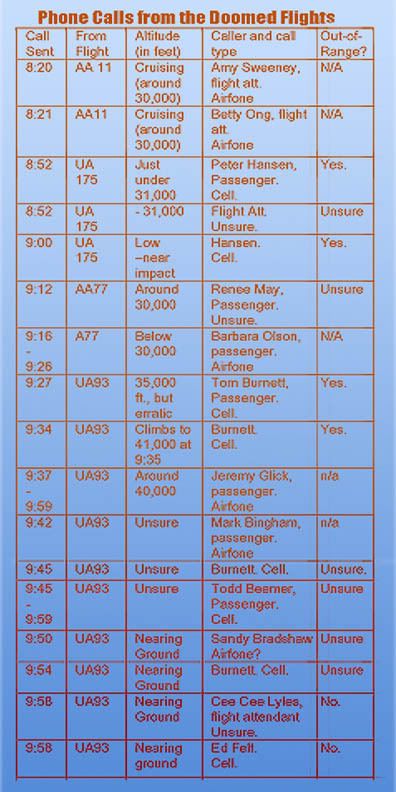
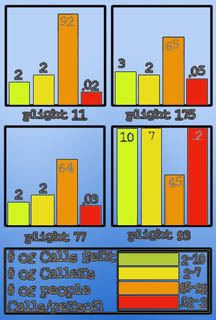
Otherwise the audio field is owned by phone calls from passenger and crew. The total number of calls to contend with is fairly low; only two to three calls each from flights 11, 77, and 175 have been published to my knowledge, in stark contrast to the flood of ten calls from Flight 93. Some of these calls were sent via “Airfone,” special phones built into and transmitted from the plane itself. They are designed to send phone signals from the air to the ground, offered in lieu of the FAA ban on cellular phones.

Others of the calls were placed via personal cell phones in spite of the ban, and it is to these that we now turn. In July 2004, American Airlines and Qualcomm jointly announced the development of a new technology that allowed passengers on a test flight “to place and receive calls as if they were on the ground.” [2] But what types of calls from the air were possible in 2001? Altitude seems to be the key. Canadian Economist and 9-11 revisionist Michel Chossudovsky explained “according to industry experts, beyond a certain altitude which is usually reached within a few minutes after takeoff, cell phone calls are no longer possible.” [3] This zone of reliability seems to have been about 8,000 feet, with normal cruising altitude around 30,000 feet, and thus, he concludes, “given the wireless technology available on September 11 2001, these cell calls could not have been placed from high altitude.” [4] Wireless Review explained: “Alexa Graf, AT&T spokesperson, said systems are not designed for calls from high altitudes, suggesting it was almost a fluke that the calls reached their destinations.” [5]

By this analysis, one caller from Flight 175 and at least one from Flight 93 made cell calls from around cruising altitude that should have been impossible. Oddly, these are also the only two callers to achieve multiple calls, all others only getting out one call each as far as I’ve seen. The pivotal Todd Beamer cell call is in the unsure middle ground, with altitude unclear and changing over the course of nearly fifteen minutes with no apparent change in reception. He talked to an anonymous Verizon operator, giving an excellent account of the heroism aboard Flight 93, providing a key element of the official story in a call that is somewhat questionable.

And for what it’s worth, Flight 93 somehow wound up yielding ten times the calls per person ratio of flight 11, with more calls than from the other three flights combined. 93 yielded ten reported calls and seven callers out of only 33 non-terrorist passengers, in a plane that can seat 182. There is no reason to doubt the government’s ability to fake these few phone calls in any number of ways, nor their ability to place them in such a way that they bear all the marks of a genuine call from one of the hijacked flights, cell phone or Airfone. But on the other hand, multiple loved ones were totally convinced - if these were faked they were faked well. There are four possibilities that these calls and transmissions represent:

- a) Audio record real, hijackers present and in charge, and flew their planes into those buildings. Shadow 9/11 is bunk.
- b) Calls real, hijackers on board in a traditional hijacking scenario, with the well-known, widely warned attack then “hijacked” via remote control, leaving the obvious presumption that the Arabs did it.
- c) Calls fake, passengers but presumably no hijackers on board, as in Scenario 12-D. All communications would be cut so the outside world didn’t find out what was really going on inside the plane, and the audio we’ve been presented is entirely faked. In this case, any hijacking attack, as mentioned in warnings, would have been pre-emptively hijacked.
- d) Calls fake, no one on board the attack planes at all. The flights were drones every one, and who knows what happened with the passengers.
- e) Any permutation or combination of these – ex: Flight 93 may have been a real hijacking, traditional or suicide, with the other three planes being drones tacked on to the existing attack, using it as cover while amplifying its traumatic nature. If 93 were a genuine hijacking, it may have even been fitted with a special prototype system like Qualcomm’s to send cell calls as if from the ground to thickly document the real terrorist presence there. The plane was then presumably shot down on Dick Cheney’s orders as it headed to Washington, and was then presumed part of the otherwise faked attack.

And remember, the very integrity of the “new American Century” is at stake here. In scenario d) above, the final fate of the passengers on the attack planes is raised, and indeed there are many convoluted theories out there to explain this. For example, the four flights may have been told of a hijacking threat, crossed radar paths with duplicate drone aircraft, as in Northwoods, as they moved to land at a safe airport. The “rescued” passengers would have been off-loaded, then loaded onto flight 93 and shot down. But Shadow 9/11’s simplest explanation is that they were simply kept on their respective planes, killing two birds with one stone and keeping the evidence consistent.

Thus I can only cite questions about cell phone calls, raise the possibility of faked calls from remote locations, note the telling slant of the audio record toward one flight (93), and finally note that if one call from 9-11 is fake, and consistent with the other calls, then clearly all are fakes. But I can’t prove anything. This is not my field, and the audio record remains the weak point of Shadow 9/11. I’ll leave it to the reader whether to dismiss the whole theory for this flaw or overlook the flaw for the sake of the big picture.

Sources:
For the call chart, I referenced The Terror Timeline (2004) by Paul thompson and the Center for Cooperative Research. I thank them for their excellent work.
[1] Vialls, Joe. “‘We Have a Bomb on Board’ Messages Faked.” September 19, 2002. Accessed Nov. 16 2005 at: http://the7thfire.com/Politics%20and%20History/Faked-Flt93-messages.htm
[2], [4] Qualcomm. Press release. American Airlines and QUALCOMM Complete Test Flight to Evaluate In-Cabin Mobile Phone Use. July 15, 2004. Accessed January 9, 2005 at: http://www.qualcomm.com/press/releases/2004/040715_aa_testflight.html
[3] Chussudovsky, Michel. “Holes in the report, the 9/11 Cell Phone Calls.” Global Research. Aug 10, 2004. Accessed Nov 20 2005 at: http://inn.globalfreepress.com/modules/news/print.php?storyid=723&PHPSESSID=ce62971b5a6eba2e58aa8c0098173a38
[5] Harter, Betsy. “Final Contact” Wireless Review. November 1, 2001. Accessed January 9, 2005 at: http://wirelessreview.com/ar/wireless_final_contact/