Showing posts with label Bush GW. Show all posts

Friday, October 12, 2007

THE CHAIN OF COMMAND ON 9/11 {masterlist}

National Command Authority
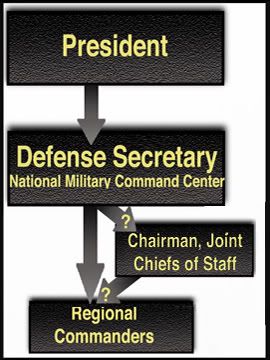
The National Defense Chain of Command in a wartime emergency at the time of the September 11 attacks was: 1) President, 2) Defense Secretary, 3) regional combatant commanders. This was established by the Goldwater-Nichols DOD reorganization Act of 1986, which also allowed that on the whim of the President and Defense Secretary, communications with and oversight of these commanders pass through the Chairman of the Joint Chiefs of Staff (CJCS – the nation’s top military officer)

Tightly controlled actions, like issuing an order for fighter jets to shoot down a civilian aircraft, constituted an emergency and had to originate with the President and pass through every link in the chain to the responsible fighter pilots. As the 9/11 Commission explained, “prior to 9/11, it was understood that an order to shoot down a commercial aircraft would have to be issued by the National Command Authority (a phrase used to describe the president and secretary of defense).” [2]

This Chain of Command was not ordinarily needed to get escort fighters off the ground – this could all be done automatically and at intermediate levels, as indicated by the swift fighter response in the Payne Stewart case. These guidelines, in effect since 1986, oddly changed just three months before September 11, with Rumsfeld asserting the sole authority to allow fighters to take off at all. This is covered in more in detail in the post "Muzzling the Defense?"

The 9/11 Commission’s final report later stated in its blameless way: “As they existed on 9/11, the protocols for the FAA to obtain military assistance from NORAD required multiple levels of notification and approval at the highest levels of government […] The protocols did not contemplate an intercept […] On the morning of 9/11, the existing protocol was unsuited in every respect for what was about to happen.” It became even more unsuited in the days and hours and even minutes before the attacks, and on the morning of September 11th, strangely, the National Command Authority’s chain of command seemed to sprout new links, swap out old ones, and seemed to not be anchored down to anything. The following posts deal with the US leadership response and the flailings and failings of a Chain of broken links.

- President Bush: “There’s one Terrible Pilot:” The accidental President Stumbles into 9/11.

- Vice President Cheney, the Roadmap Swap, and the “Effort.” Clarifying the Record. Did Bush hand Cheney the joystick to control the attacks?

- Cheney and the Shoot-Down Order: Who issued the order and when? 9:45, 10:14, 10:18?

- Link #2 AWOL: Psychic Rumsfeld’s Wanderings

- Myers the stand-in: How he responds "when things are happening."

- First Day Jitters: Sliney, Leidig, Myers: Three Defense Links Swapped out at the last minute at Joint Chiefs of Staff (ACTING Chairman richard Myers, as of ?:00 am, 9/11) Benedict Sliney at FAA Operations Center (first day as of ?:00 am, 9/11) and Leidig at the NMCC (see chart below - standing in as of 8:30 am, 9/11, as per a request from the previous day). This is spooky.

In the end, what we got was a startlingly "unprepared" and disjointed command authority that ran something like this:

Friday, July 27, 2007

WAR GAME 5: GLOBAL GUARDIAN

WAR GAME 5: GLOBAL GUARDIAN
Adam Larson / Caustic Logic
They Let It Happen
Last updated July 27 2007


The Center for Cooperative Research patched together this description of the periodic exercise Global Guardian, directed from the US Strategic Command (STRATCOM) center, a bunker set beneath Offutt Air Force Base in Nebraska:

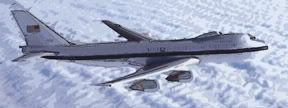
"[T]hree special military command aircraft with sophisticated communications equipment, based at Offutt, are up in the air the morning of 9/11. These E-4B National Airborne Operations Center planes—nicknamed “Doomsday” planes during the Cold War—are intended to control nuclear forces from the air in times of crisis. They are capable of acting as alternative command posts for top government officials from where they can direct US forces, execute war orders and coordinate the actions of civil authorities in times of national emergency. [...] Media accounts indicate Global Guardian is cancelled at Offutt shortly after the second WTC tower is hit (at 9:03 a.m.), with staff switching to “real-world mode.” However, even after Global Guardian is called off, the three E-4Bs remain airborne." [1]


The exercise's details and exact purpose remain vague, but it seems to be related to "Continuity of Government" exercises also carried out in the 1980s with E4-Bs and background officials like Don Rumsfeld and Dick Cheney. [2] Whatever the exercise really was, it was it was “in full swing” when the attacks began. Researcher Mark H. Gaffney looked into reports of the mysterious white plane seen and filmed over Washington DC has shown that this was almost certainly a whie, 4-engine E4-B, presumably one of the Global Guardian participants, though there appears to be a massive cover-up of the plane, which apparently must remain secret even after being filmed in broad daylight. [3]

By 2006 anyway, GLOBAL GUARDIAN, along with a space-oriented APOLLO GUARDIAN exercise, are "conducted in conjunction" with the more well-known Vigilant Guardian Exercise. [4] VG was also in full swing on 9/11, so it seems they were allied at the time, officially or otherwise. Gaffney also found that the exercise's being conducted at that time really is an unusual coincidence:

"In previous years the military always staged Global Guardian in October or November; and the 2001 exercise was likewise originally scheduled for October, according to various reports. Curiously, however, for reasons never disclosed, the Joint Chiefs changed the plan and conducted the 2001 exercise during the week of September 11. The following year the date reverted back. The 2002 Global Guardian came off in October, as in previous years, and this has continued to be the case." [5]

Total Coincidences?
CCR: "The Federal Advisory Committee (whose chairman is retired Lt. Gen. Brent Scowcroft) is aboard one of these Doomsday planes, being brought to Offutt to observe the exercise. [...] a small group of business leaders are at Offutt Air Force Base for a charity fundraiser event due to take place there later in the day, hosted by the multi-billionaire Warren Buffett. When the attacks begin, these visitors are having breakfast with Admiral Mies, the director of Global Guardian. After the second WTC tower is hit, Mies excuses himself from the group, presumably to assist in canceling the exercise." [7] Later in the afternoon, President Bush and Air Force One landed at Offutt "as a security precaution." It was his second landing since leaving Florida, and he convened a teleconference with the National Security Council from there. [7]

Sources:
[1], [6] Center for Cooperative Research. “Before 9:00 a.m. September 11, 2001: Offutt Air Force Base, Nebraska, is Directing Global Guardian Training Exercise.” http://www.cooperativeresearch.org/context.jsp?item=a900offutt
[2] "Between 1981 and 1989: Officials Airborne in Doomsday Plane." http://www.cooperativeresearch.org/context.jsp?item=a81doomsdayplanes#a81doomsdayplanes
[3], [5] Gaffney, Mark H. "The 911 Mystery Plane - First in a Series." Rense.com. 4-5-7 http://www.rense.com/general76/missing.htm
[4] Global Security: Vigilant Guardian. http://www.globalsecurity.org/military/ops/vigilant-guardian.htm
[7] "Bush Reacts to Attacks, Moves to Nebraska." By Mike Allen. Washington Post. Tuesday, September 11, 2001; 4:36 p.m http://www.washingtonpost.com/wp-srv/nation/articles/bush091101.htm

Monday, May 7, 2007

BUSH, CHENEY, AND SECRET SERVICE COMMUNICATIONS

Adam Larson / Caustic Logic
They Let It Happen
last updated 5/7/07


A year after the attack, CNN retold Vice President Cheney’s version of what happened. Cheney was in his proper office in the West Wing when he heard that a plane had crashed into the WTC. Unlike everyone else whose reactions I’ve looked at - with the notable exception of counter-terrorism “Czar” Richard Clarke - Cheney had an inkling this may not be a simple accident. “He watched TV and hoped that his instincts were wrong.,” CNN reported. He explained “it was a clear day, there were no weather problems, and then we saw the second airplane hit in real time. At that moment, you knew this was a deliberate act. This was a terrorist act.” [1]

Shortly after this, his Secret Service agent “all of a sudden materialized right beside me and said, 'Sir, we have to leave now.' He grabbed me and propelled me out of my office, down the hall, and into the underground shelter in the White House." [2] So while, as many noted, the Secret Service was allowing the President to linger in the open at the schoolhouse, they were “propelling” Cheney to safety in an underground bunker. While both men were on the East Coast, they seemed to be operating in two different time zones.

This underground shelter was the Presidential Emergency Operations Center (PEOC). From the previously unused but well-equipped PEOC, as CNN explains, the Vice-President “directed the U.S. government's response” to the attack. The actions Cheney took “included moving key members of Congress to a secure location and having the Secret Service bring his wife, Lynn, to the bunker.” [3] Somehow, these radical moves failed to halt the attack.

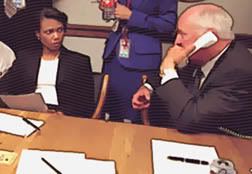
Cheney and Rice share a tense moment in the PEOC on 9/11. Photo chosen for presence of Cheney on the phone.
Cheney’s account actually offers little in the line of useful action, focusing more on talk of raw emotion – agony and impotence and rage – just like the rest of us – after he saw the second plane hit on the TV - just like the rest of us. But Bush talked to Cheney on a regular cell phone instead of a secure phone, which wasn’t working right. Cheney’s information seemed partial and confused. The 9/11 Commission, based on Cheney’s private testimony, decided Cheney suffered major communications problems that hampered a response. [4] CNN described the PEOC’s performance on 9-11 “a day of crisis with some hitches.” For example, “Cheney wanted to track TV reports of the devastation and listen in on communications with the Pentagon.” But, as aide Mary Matalin recalled, “you can have sound on one or the other and he found that technically imperfect.” [5]

But we know he was in the presence of Secret Service agents during the entire crisis, and the evidence indicates their communication abilities were widespread and efficiently used. Cheney seemed to slip on this once, telling Meet the Press, on September 16 “the Secret Service has an arrangement with the FAA. They had open lines after the World Trade Center was ...” [6] He cut himself off there and shifted gears. What this means is that after the first plane hit, and we would presume soon after, the Secret Service knew, and were listening in on, at least, the FAA’s communications by about 8:50. The second plane was already confirmed hijacked by FAA and NORAD and headed to New York by this time.

Richard Clarke also testified in his book Against All Enemies that at about 9:40, Brian Stafford, Director of the Secret Service “slipped me a note. “Radar shows aircraft headed this way.’” Clarke explained “Secret Service had a system that allowed them to see what FAA’s radar was seeing.” [7] The 9/11 Commission also has backed up direct Secret-Service-FAA communications in their final report. [8] The Secret Service knew all these things and were just a “hey, you!” away from Cheney’s ear and Bush’s.

The communication abilities of the Secret Service also, apparently, extended into the military chain of command, their contacts to the very front lines of the battle. Recall that it was the Secret Service who called the Langley fighter pilots around 9:55 and told them to “protect” the White House (though with no mention of precisely how). [9] They also called Andrews Air Force Base, near the Pentagon, shortly after 9:03 to request fighter jets, which didn’t get any off the ground until 10:42. [10]

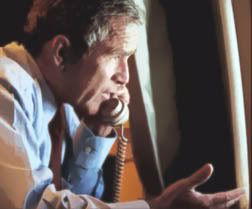
Bush's famous shot talking to Cheney from Air Force One
So the Secret Service - and thus both Bush and Cheney - were as in the communications loop as they wanted to be. There was two-way access to all information from FAA, regional Air Force bases, and even the actual fighter pilots, and probably also NORAD, NMCC, etc. So why, with access to a bird’s eye view of the situation and universal communications at Cheney’s and the President’s fingertips, wasn’t an adequate defense marshaled? The story that the phones didn’t work well that day, that Cheney couldn’t talk to the Pentagon and get his intelligence briefings from CNN at the same time, etc. does not pan out well. Something else, probably something sinister, had to be behind this curiously long roster of excuses.

[1], [2], [3], [5] “Cheney recalls taking charge from bunker.” CNN. September 12, 2002. Accessed at: http://archives.cnn.com/2002/ALLPOLITICS/09/11/ar911.king.cheney/
[4] 9/11 Commission Final Report. Page 40.
[6] Thompson and the CCR. "The Terror Timeline." Page 375.
[7] Ruppert, "Crossing the Rubicon." Page 427.
[8] 9/11 Commission Final Report. Page 41.
[9] Thompson and the CCR. "The Terror Timeline." Page 436.
[10] Thompson and the CCR. Page 458.

Tuesday, May 1, 2007

THE PROJECT’S PHASED TAKEOVER: 9/20-10/11/01

ONE MONTH OF "MORAL CLARITY"
Adam Larson/Caustic Logic
Posted 4/30/07


For whatever It’s worth, it was the 102nd birthday of the late neocon intellectual godfather Leo Strauss when, on September 20th 2001, as President Bush prepared to give an address to a special joint session of Congress pitching the “War on Terrorism” to a stunned nation, the PNAC delivered an open letter to Bush entitled, humbly, “Lead the World to Victory.” [signed by Kristol, Bauer, Cropsey, Cohen, Gaffney, two Kagans, Perle, Podhoretz, Schmitt, etc.] Full text available here.

The letter lauded Bush’s tough response to the attack and his framing of it as a war, and praised the administration’s public assertions that the campaign would be fought on many fronts, and early hints that it would not be limited to al Qaeda. They encouraged this thinking and suggested some of their own ideas as to what other fronts should be opened; for starters, they offered Hezbollah, the Palestinian Authority, and, of course, Iraq, with a hint of more threats to come. These suggestions bore more similarity to an Israeli wish-hit-list than any realistic response to the nine-day-old 9/11 attacks. The proposals of the letter could have just as easily been passed on by Cheney, (and probably already had been) but they wanted it to look open, and perhaps more importantly, to bring their ideas to the attention of the stunned and suggestible public on the same day Bush was going public with his own guaranteed war proposal. It was a highly visible formal entreaty to cover for pre-arranged back-room deals that became evident as Bush spoke that evening.

The nation drew in a breath and listened; just nine days after the attack, and after much discussion with his august advisers, Bush already knew the shape and scope of the war at hand. He informed his fellow Americans that “this war will not be like the war against Iraq a decade ago, with a decisive liberation of territory and a swift conclusion. It will not look like the Air Wars above Kosovo two years ago, where no ground troops were used and not a single American was lost in combat… Americans should not expect one battle, but a lengthy campaign, unlike any other we have ever seen.” IWith his fatwa “either you are with us, or you are with the terrorists,” Bush charted a clearly unilateralist direction – we were going this way, others would either follow or hold back at their own risk, a clear nod to the PNAC’s Concept of unilateralism (or, more accurately, multilateralism via “global leadership”). He had almost certainly read the Project’s letter well before he spoke, and had likely already acceded to all of its major proposals.

The following day, Charles Krauthammer’s essay “Voices of moral obtuseness” appeared in Time, arguing the same case as the PNAC’s letter. He had, in fact, signed the letter. Krauthammer lamented that “in the wake of a massacre that killed more than 5,000 innocent Americans in a day, one might expect moral clarity,” but we were instead hearing criticism of U.S. policy, what he saw as a relativist, liberal “we had it coming” attitude. He was of course right in his observation that the attack was an “event of blinding clarity,” although I’m not sure he sees the irony in that phrase. Krauthammer noted the earlier dissolution of anti-war and isolationist sentiment following the attack on Pearl Harbor, an analogy that had to have his colleagues at the PNAC smiling as they set about implementing their "process of transformation."

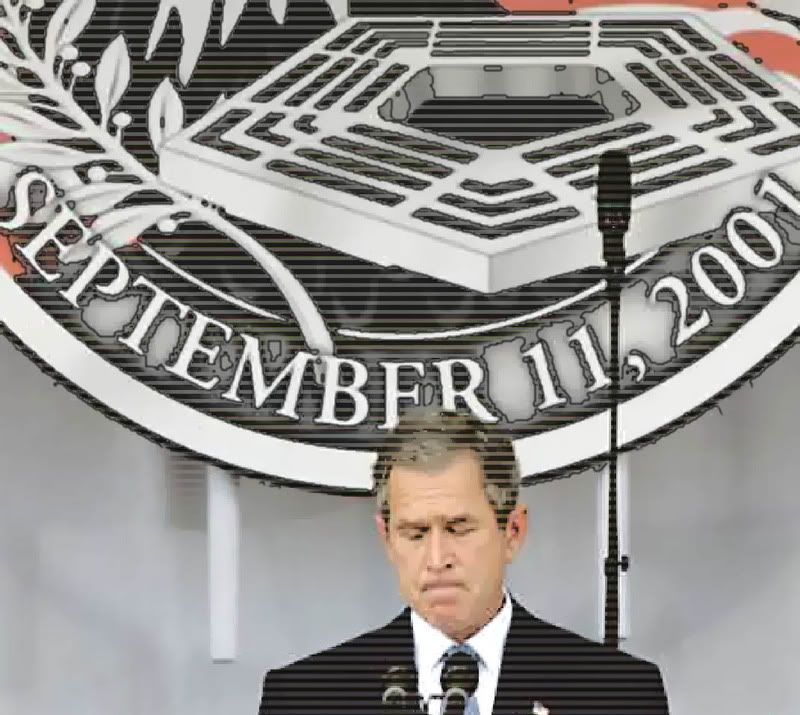
One month after the attack, Bush delivered a speech at the wounded Pentagon, offering a more concrete assurance of his dedication to the PNAC vision. On a dreary Thursday morning, October 11th, 2001, he reassured the Project, on at least four key points, that 9-11 was indeed the fulfillment of their year-old report Rebuilding America’s Defenses.

Bush’s Address at the Pentagon, October 11, 2001: “Brick by brick, we will quickly rebuild the Pentagon.”
1) He noted “as Americans did sixty years ago, we have entered a struggle of uncertain duration.” This was perhaps code for “new Pearl Harbor.”

2) Perhaps in response to the PNAC’s call for increased ”defense” budgets, Bush assured them “in the missions ahead for the military, you will have everything you need, every resource, every weapon, every means to assure full victory for the United States and the cause of freedom.”

3) Bush reassured them that “brick by brick, we will quickly rebuild the Pentagon.” It’s interesting to note that the Pentagon did not need to be rebuilt, just repaired. But he didn’t say repaired; he said the Pentagon would be re-built, possibly code for a Rebuilding America’s Defenses. And it would be done “quickly,” as in the desired speed of the “process of transformation.”

4) The report had called for the U.S. to “fight and decisively win multiple, simultaneous major theater wars.” A year and a month later, Bush reassured them and the world that “we have a unified country. We have the patience to fight and win on many fronts.”

It appears the PNAC was essentially quite pleased with the direction the Administration was taking, following their road map to the expansion of the Pax Americana and to continued “American global leadership.” Bush in turn seemed pleased with the response to the attack that the PNAC had prepared a year before it happened. Of course, they all had to understand the irony that this road map would not have been followed so quickly, as the Project had earlier noted, without the realization of the “new Pearl Harbor.” It turned out well for the Project; their laboriously crafted roadmap was being followed, and they set about refining its details and positioning the military’s machinery to start moving by it. By the time of Bush's 10/11 speech, bombs were already falling on Afghanistan, troops and aircraft carriers were soon moving to all the other pushpins on the Pentagon’s big map, and the plan to take Iraq was put into motion. Their “New American Century” had begun with a bang.

Saturday, March 3, 2007

CHENEY AND THE SHOOT-DOWN ORDER

White House Conter-terrorism Czar Richard Clarke explained in his account of 9/11 how at 9:30 he told his deputy in the PEOC to inform Vice President Cheney “we need to authorize the Air Force to shoot down any aircraft […] that looks like it is threatening to attack […] Got it?” [1] Accounts differ as to whether or not the vice president “got it” at this point, but Clarke says the shoot-down order was agreed upon by Bush and Cheney some time before the president’s plane took off at 9:55. This was in a call he remembered getting from his deputy with Cheney who informed him “Air Force One is getting ready to take off […] fighter escort is authorized. And […] tell the Pentagon they have authority from the President to shoot down hostile aircraft, repeat, they have authority to shoot down hostile aircraft.” It’s not clear why this aide thought Clarke was a link in the Chain of Command to pass the order on, but Clarke wrote “I was amazed at the speed of the decision coming from Cheney and, through him, from Bush.” [2]

But at least one other account seems to back up an even earlier order. Recall that Cheney was informed of flight 77 closing in on Washington at about 9:33. Transportation Secretary Norman Mineta told the 9-11 Commission in 2003 that he saw Cheney give what he interpreted as a shoot-down order at this time. [3] The BBC documentary Clear the Skies records Mineta’s recollection of a plane reported coming in fast. Cheney was informed it was 30 miles out, and he ordered it shot down. He was informed again that it was 10 miles out and the aide asked if the orders still stood. Mineta recalls “the vice president sort of whipped his head around and said “of course they do.” [4] This account was placed in the documentary, which is based on a ticking timeline of the events, in the time slot right before the Pentagon impact at 9:37.

But the official story is that the order was finally transmitted from the President to Cheney, with a casual “you bet,” at just about 10:05, for sure before 10:10, or maybe 10:18 - this has been hotly contested. The 9-11 Commission, in a rare and curious show of contrariness, got into a bit of a brawl with Cheney over this phone call. In June 2004, as the final report was released, Newsweek reported:

“[S]ome on the commission staff were, in fact, highly skeptical of the vice president’s account and made their views clearer in an earlier draft of their staff report […] some staffers “flat out didn’t believe the call ever took place.” When the early draft conveying that skepticism was circulated to the administration, it provoked an angry reaction […] the White House vigorously lobbied the commission to change the language in its report.” [5]

Cheney and Rice share a tense moment in the PEOC on 9/11. Photo chosen for presence of Cheney on the phone.
The Commission finally caved to Cheney’s protests and simply concluded in their final report “there is no documentary evidence for this call.” But they did get some subtle hints of this earlier argument worked in. For example, they note that neither Cheney’s wife Lynn nor his Chief of Staff Libby, who were nearby, can recall this call being made. [6]

By 10:15, Cheney was ordering a phantom flight shot down, saying the President had “signed-off on the concept.” Cheney’s Deputy Chief of Staff Joshua Bolten, Libby’s underling, urged Cheney to “confirm the engage order,” since he “had not heard any prior conversation on the subject with the President.” [7] This confirmation call, unlike the first, was logged at 10:18 and found by the commission. The final report also notes that Bush informed Press Secretary Fleischer at 10:20 that he had just passed on the historical shoot-down order.

The clear but subtle implication is that perhaps Cheney issued this order on his own and only ran it by Bush at 10:18 – or at least Libby, Lynn, Bolten, and the 9/11 Commission have made it look that way, for reasons that are unclear. But Bush stubbornly insists standard procedure was observed, and that he passed the order on whenever Cheney says he did. He said this in the secret hearing he had with the commission in Cheney’s presence, not under oath, off the record, with no recordings, minutes, or direct quotes allowed. They summed up Bush’s recollection:

“The President said he remembered such a conversation, and that it reminded him of when he had been an interceptor pilot. The President emphasized to us that he authorized the shootdown of hijacked aircraft.” [8]

Much has been made of Cheney’s aggressive application of the shoot-down order once he finally had it. In an incident eerily similar to Mineta’s recollection cited above, Cheney urged the shoot-down of United 93 as it was reported closing in at about 10:10. This was read by the Secret Service as a radar track, but, the Commission concluded, was actually a projection of 93’s path if it ,hadn’t just crashed. But it gave Cheney a chance to do something. Informed the plane was eighty miles out, Cheney quickly “authorized fighter aircraft to engage the inbound plane.” Again he was informed when the projected plane was 60 miles out and wanted to know if the order still stood. “Scooter” Libby described Cheney’s confirmation to the 9-11 Commission as swift - “in about the time it takes a batter to decide to swing.” [9] But he only started swinging almost the exact minute there was nothing left to swing at, giving an impression of decisive leadership without actually screwing up a perfectly good terror attack.

Besides the vague possibility of ordering the shoot-down of 93 without the Presiden't approval, another Cheney contribution to the 9/11 mythos is his instant response to the plane's crash. Once it became clear that 93 had gone down short of Washington, everyone wondered if it had been shot down. Yet without any of the evidence that would later surface from the audio record of the doomed flight’s last moments, without the benefit of having heard anyone cry “let’s roll,” Cheney already knew the official story. “The Vice President was a little bit ahead of us,” said Eric Edelman, Cheney's national security advisor. “He said sort of softly and to nobody in particular, ‘I think an act of heroism just took place on that plane.’” [10] What an eerily acurate guess.

[1] Clarke, Richard A. “Against All Enemies: Inside America’s War on Terror.” New York. Free Press. 2004. Page 7.
[2] Thompson, Paul and the Center for Cooperative Research. "The Terror Timeline: Year by Year, Day by Day, Minute by Minute." New York. Regan books. 2004. Page 431.
[3] See [2]. Thompson. Page 431.
[4] "Clear the Skies." BBC Video. 2002.
[5] Klaidman, Daniel and Michael Hirsh. “Who was Really in Charge?” Newsweek. June 28, 2004.
[6] National Commission on Terrorist Attacks Upon the United States. The 9/11 Commission Report. Authorized First Edition. New York. W.W. Norton. 2004. Pages 40-41
[7] See [5]. Klaidman and Hirsh.
[8] See [6]. Page 40.
[9] See [6]. Page 41
[10] CNN. “Cheney recalls taking charge from bunker.” September 12, 2002. Accessed at: http://archives.cnn.com/2002/ALLPOLITICS/09/11/ar911.king.cheney/

Monday, February 12, 2007

ROADMAP SWAP/CHENEY’S “EFFORT”

BEFORE AND AFTER MAY 8: CLARIFYING THE RECORD
Adam Larson
Caustic Logic/They Let It Happen
December 17 2006


Office of What?
Cheney_Sinister
Dick Cheney: behind the scenes = behind it all? Who could NOT suspect that face?
There has been much attention and much confusion within the 9/11 Truth community centered on the mysterious mid-2001 “counter-terrorism task force” headed by Vice President Cheney and its possible role in the 9/11 attacks. From this has emerged three main takes: the passive LIHOP (Let it Happen on Purpose), active LIHOP (scramble defense on 9/11), and MIHOP (Make It Happen on Purpose) interpretations, each with their variations.

- Basic gist for a passive LIHOP theorist: Bush creates a task force to “prevent” terrorist attacks, tasking it to Cheney, whose pals want a “New Pearl Harbor.” Cheney gets the staff going just one day before 9/11 and so it fails to prevent the attack. Cheney’s stalling prevented implementation of previously recommended measures that could have stopped the 9/11 hijackers on the ground and so is evidence of allowance, which was also alleged – if not proven - over the original Pearl Harbor attack.

- Active LIHOP: In addition to maybe leaving the door open to the terrorists, Cheney prepared the field for the attack by scheduling several air-based military war games, some of which had fighter jets sent far away from the East Coast, and others whose similarity to the attack confused air defenses.

- Basic MIHOP (Make it Happen on Purpose) interpretation: Cheney used this task force to “prepare” for the attack by mobilizing FEMA Urban Search and Rescue teams to Manhattan the night before, presumably to facilitate evidence removal after the demolitions. And he arranged the war games, whose programming and possibly “live-fly” drones may have actually carried out the attack rather than just opening the skies. The “worst fears” being prepared for came true, and Cheney probably coordinated it all through his task force and an unidentified “Maestro.”

While all three and their various derivative theories are intriguing and have their evidence, I have a strong case to argue that these theories are seriously flawed. I myself was suckered in to the particular MIHOP interpretation at one point, seeing in it a neat way to tie the reviled Dick Cheney in with the war games of 9/11 and even the deployment of the FEMA rescue workers allegedly in Manhattan the night before the attack. Mike Ruppert was pushing the first half of that (but decidedly not the second), and it seemed intriguing and quite plausible. But the more research I do, the less clear all these links become. It’s not to say they aren’t there, just that if they are they aren’t as in the open as people seem to think. After I cover the flaws with both the LIHOP and MIHOP takes, I’ll propose a third interpretation of the import of this elusive agency.

There is a lot of confusion around the issue, enough so that people don’t even agree on what precisely to call the thing: Gregor Holland, in a 2004 piece from the New Zealand site Scoop (and later re-run by Prison Planet), explained that “the Office for Domestic Preparedness was the effort assigned to Dick Cheney by George W. Bush on May 8, 2001.” [1] But The Office for Domestic Preparedness (ODP), which Holland correctly cites as an entity within U.S. Department of Justice, was actually created at DoJ in 1998 “to develop and administer training and equipment assistance programs for state and local emergency response agencies.” [2] The Center for Cooperative Research got it much closer, reporting in their timeline “May 8, 2001: Bush entrusts Vice President Cheney to head the new Office of National Preparedness, a part of FEMA.” [3] A 2002 House of Representatives report made no mention of a Cheney role in Bush’s creation of the Office of National Preparedness (ONP) on May 8 “for greater coordination among federal agencies in responding to a terrorist attack." They also noted "the President located the ONP within FEMA,” not in the White House. [4]

Bush’s original May 8 order stated the ONP “will be responsible for implementing the results of those parts of the national effort overseen by Vice President Cheney that deal with consequence management.” [5] The ONP were the front line water carriers to implement Cheney’s findings, and so there was clearly a higher level than them where these decisions were made, based not at FEMA but in the White House. As far as I can tell, this has no name, most commonly referred to as the “effort” that was indeed tasked to Cheney on May 8. It was neither ODP or ONP. The 9/11 Commission referred to this vaguely as “an effort looking at preparations for managing a possible attack by weapons of mass destruction and at more general problems of national preparedness.” [6] “Looking at” means a committee-oriented review process to give the ONP its direction, so I call this higher level “Cheney’s effort” or “the effort.”

The Roadmap Swap and the LIHOP take
Before I relate more on the May decree, we need to understand the timing “coincidence” I call “the Roadmap Swap.” It began on January 31 2001: Bush was just sworn-in as the 43rd President, with Cheney and all the PNAC people looking for their “new Pearl Harbor” on his coattails. That day, an elite panel was just completing its own assessment of the threat of such catastrophic events in the coming decades: The U.S. Commission on National Security in the 21st Century. Created by President Clinton and House Speaker Newt Gingrich in 1998, and co-chaired by former Senators Gary Hart (D) and Warren Rudman (R), the commission unveiled their new report “Roadmap for National Security: Imperative for Change” at a press conference. Among the excerpts read live by Gary Hart on January 31 2001 was this ominous prophecy:

“States, terrorists, and other disaffected groups will acquire weapons of mass destruction, and some will use them [...] Americans will likely die on American soil, possibly in large numbers. […] Our military superiority will not entirely protect us” [7]

According to Hart, Congress began to take the commission’s suggestions seriously in March and April, and started introducing legislation to implement some of the recommendations, one of which was the creation of something called a “Homeland Security Department.”” [8] The commission scheduled another meeting for May 7, hoping some administration officials would attend this time. Instead, the meeting was cancelled and replaced with a brand-new policy review process. Hart said of the ultimate end of his commission “frankly, the White House shut it down […] The President said ‘please wait, we’re going to turn this over to the Vice President.” [9]

As National security Adviser Rice later explained, “The vice president was later, I think in May, tasked by the president to put together a group to look at all of the recommendations [from] the Gilmore report and the Hart-Rudman report and so forth and to try to make recommendations about what might have been done.” [10] This is where the May 8 decree comes in, apparently timed to answer the questions raised by the cancellation of Hart-Rudman’s scheduled meeting the previous day, and Bush’s statement seemed to address what they had probably meant to talk about. “No governmental responsibility is more fundamental than protecting the physical safety of our nation and its citizens,” the one-page release stated, so “I have asked Vice President Cheney to oversee the development of a coordinated national effort so that we may do the very best possible job of protecting our people from catastrophic harm.” Bush explained that the responses to a successful WMD attack were widely tasked to various agencies, a recipe for disaster. He expressed the need for these responses to become “seamlessly integrated, harmonious, and comprehensive.” [11] The release offers very little insight into Cheney’s role, mostly dedicated to explaining the new ONP, which Bush asked FEMA Director Joe Allbaugh to create.

Much has been made of the relevance of this swap, comparing the slow pace of Cheney’s effort compared to the urgency recommended by the Hart-Rudman Commission. Paul Thompson concluded in The Terror Timeline (2004) that the January report put forth fifty suggestions to "stop terrorists inside the US,” but every one was “ignored by the Bush administration.” Former Senator Gary Hart (D) later implied to Salon in April 2004 that the ONP/Cheney effort was created to prevent Congress from acting on his commission’s findings – though the purpose was left unexplained. [13] Apparently Al Franken made a big deal of satirically calling the Bush response to the Hart-Rudman plan “Operation Ignore.” Dave Pierre at the “Frankenlies” website took issue with this: “Franken leads many readers to believe that the commission’s report was some urgent call for President Bush to revamp the entire national security infrastructure immediately,” and that their refusal to do so may have contributed to 9/11. But Pierre aptly pointed out that “the Commission’s report clearly took a long-range outlook on how the United States should approach its national security," specifically, over 25 years. "In fact, the commission wrote, ‘We propose significant change, and we know that change takes time.’” [14]

In other words, if the roadmap swap really was meant as a delaying operation, either to deny a bi-partisan plan in favor of the Cheney/PNAC model, or to keep the road to 9/11 unobstructed - it was hardly needed. No recommendations were really expected except in the span of years and election cycles, not four-month cycles. If the Commission’s plans had been allowed to run their course, 9/11 would still have occurred. Scratch the passive LIHOP take, Cheney’s effort has nothing to do with it.

Hands-On Management?
Then to the active LIHOP and MIHOP interpretations: The few mainstream reports I’ve seen paint Cheney's effort as strictly paper-pushing review, but many in the Truth movement see something more sinister. For example, in Crossing the Rubicon, Mike Ruppert takes the stance that this task force put Cheney in “a quiet but unequivocal hands-on management role, before, during, and after 9/11.” He flatly asserts that the May 8 Order “placed Dick Cheney in charge of planning, preparing for, and coordinating all US response to the terror attack,” response that went well beyond FEMA ground response to the strikes and up into the military level of the air defense. [15] Considering the aberrantly poor response that then happened four months later, this is a damning charge.

I have respect for Ruppert’s works and have in the past considered myself a fan, but in this case at least I’m not so sure he has adequate evidence to back up this claim. For example, Ruppert decided the order tasked Cheney’s effort with coordinating “planning and training” against terror threats, a central part of his linking Cheney with the war games of 9/11, at least one of which posed a hijacking threat. But the release actually tasks the ONP, not Cheney, with “planning, training, and equipment needs” of local first responders, and placed naither in charge of scheduling war games.

So the nation's response to a WMD attack was to be looked at, tinkered with, and perhaps indirectly run by the enigmatic Dick Cheney - shortly after his colleagues at the PNAC had noted the utility of a “catastrophic and catalyzing event, like a new Pearl Harbor.” Four months later the worst terrorist (non-WMD) attack in Human history occurred, seamlessly sliding through all defenses and causing catastrophic (and catalyzing) harm to the American people, with a death toll on par with the “old” Pearl Harbor. While all this seems somewhat beyond the realm of coincidence, especially considering the relative rapidity of these events lining up within one year, to imply direct connections between them at this point seems premature. In the days before the attack, the coincidences would only get more precise and chilling, but not necessarily more relevant.

Abbot Helms “The Effort”
Adm Steven Abbot
Admiral Steven Abbot, Director of Cheney's "effort," in October 2001
The 9/11 Commission explained that after the May 8 announcement creating Cheney’s effort and the ONP “the next few months were mainly spent organizing the effort and bringing an Admiral from the Sixth Fleet back to Washington to manage it.” [16] Cheney's first hire in June was his point man on coordinating the effort, Navy Admiral Steven Abbot, who has now become one of Mike Ruppert’s “persons of interest” in 9/11. He is a Rhodes scholar with an impressive military career, being a top commander in Europe during the conflict in Kosovo, and just retired as he got his new call to duty. Cheney also hired an embryonic staff of two to assist Abbot: researcher Carol Kuntz, who started her review right away, and Col. John Fenzel III, formerly director of Cheney’s secretive Energy Task Force and now Abbot’s staff director. [17] They were to report to Congress on their findings by October 1, a deadline that must have seemed impossible as September dawned and they still had no staff to direct and no base to operate from.

The 9/11 Commission reported “the Vice President’s task force was just getting under way when the 9/11 attack occurred.” [18] In fact Abbot, Fenzel and Kuntz were finally given White House security clearance and got to work on the day before the fateful attack. [19] Abbot told the Congressional Quarterly in 2004 “I didn’t begin to work full time [on the effort] until early September. I got my pass to the White House complex on the 10th of September.” [20] What, if anything, did this staff do in the next 24 hours?

While Abbot’s official job was purely review – that is, research and recommendation - he did bring his connections and his many skills to the table. Ruppert found that Abbot was a trained fighter pilot, insanely experienced with a variety of craft, routinely hired as a test pilot for new technologies, and generally one with supreme understanding of managing the air dimension. Thus, Ruppert reasoned, Abbot may be an excellent candidate for Maestro, the coordinator of air-based exercises on 9-11 that “jump-started” response to the attack. [21]

Ruppert claims Abbot had also previously been in charge of the National Military Command Center (NMCC) beneath the Pentagon, the war room that sat empty of leadership on 9/11 while Rumsfeld and Myers ignored the attack. The acting NMCC Director that morning had been Captain Charles Leidig, asked to stand-in the day before for 90 of the 111 minutes of the 9/11 attack. Both having been from the Navy, Ruppert wondered “if Leidig and Abbot had ever served together or if Abbot had any influence in Leidig’s placement in the NMCC,” a placement which was, after all, requested bare hours after Abbott punched in for his first day of work at the White House. [22] No matter what to make of it all, this Cheney-Abbott-Leidig seam sewn into the fabric of the 9/11 story just about 24 hours before the actual attack is a highly curious and intriguing coincidence and makes Ruppert’s overall case start to make sense.

It's also worth noting that Abbot’s whereabouts and actions during the attack have not been publicized as far as I’ve seen. He was not questioned by the 9/11 Commission in any of their twelve public hearings, and was not even mentioned by name in their final report, referred to only as “an admiral from the Sixth Fleet,” (his name is in the footnote for this, citing a previously existing book by Steven Brill.) The Commission either never asked after him or he never returned their calls. As the man leading Cheney’s new preparedness task force, to be absent from all accounts as the biggest lack of preparedness in history happens on his second day on the job – and to remain unquestioned and virtually unnamed - that’s certainly anomalous, and raises the question of what skill set he was really using that morning.

A Post-9/11 Script Written in a Pre-9/11 World
While all this is speculation, what is known is that the attack gave Abbot and some of those around him a quick promotion; Cheney’s effort was the seed that would become the previously recommended Homeland Security Department. A White House spokeswoman later stated “the president was able to very quickly after September 11 stand up the Office of Homeland Security [since] a great deal of work had already been put into this issue.” [23] This was mainly the work that Carol Kuntz had overseen in mid-2001, and even in retrospect looks like a logical follow off of the Hart-Rudman Commission’s recommendations. Thus it should not be surprising that a White House press release from October 29 announced that Abbot was being promoted to the new Office of Homeland Security, as its Deputy Director, directly under Tom Ridge. [24]

So essentially what happened is previous ideas on securing the homeland were taken in together by Cheney’s effort, reviewed by Abbot’s crew, and, after the attack that clarified its need, used to set up the Office of Homeland Security and eventually DHS. Thus on May 8, Bush essentially tasked Cheney to create the Department of Homeland Security, which wouldn’t even make enough sense to do outright until after 9/11. This may be a coincidence, as the government certainly would argue if asked, but it is a rather spooky seam of foresight I think. Thus far it’s been largely eclipsed by these charges that Cheney’s effort was precisely the mechanism for allowing or orchestrating the attacks. It was probably no more responsible than its counterpart the USA PATRIOT Act, also clearly written before 9/11 considering its haste of production and signing into law as soon as it made sense - one month after the attacks, and a few days after the Anthrax Scare that had cleared capitol Hill.

Recall as well that a plan for the war in Afghanistan and a global campaign against al Qaeda was placed on Bush’s desk September 9. According to Paul O’Neill and others, the war in Iraq was largely planned before 9/11. The Patriot Act was written, and as we’ve just seen, the skeleton at least of the DHS was set up shortly before 9/11 as well. These are facts, and whether Bush gave Cheney the joystick to control the actual attacks or not, the general thrust of the Post-9/11 world was already set. You tell me: what does effort thusly directed in the months between Bush’s coronation and the “catalyzing event” really imply? Let It Happen? Make It Happen? Or simply It Will Happen?

Sources:
[1] Holland, Gregor. "UQ Wire: Long Debunked Rumor Validated by Giuliani: FEMA in NYC prior to 9-11 for Project TRIPOD terror drill, scheduled for 9-12." Scoop, Independent News. June 3 2004. http://www.scoop.co.nz/stories/HL0406/S00031.htm
[2] "Office for Domestic Preparedness." Federation of American Scientists. http://www.fas.org/irp/agency/doj/ojp/index.html
[3], [13] "Profile: Office of National Preparedness." Center for Cooperative Research. http://www.cooperativeresearch.org/entity.jsp?entity=office_of_national_preparedness
[4] The Subcommittee on Economic Development, Public Buildings, & Emergency Management Hearing on The Federal Emergency Management Agency’s Office of National Preparedness. April 11 2002.
http://www.house.gov/transportation/pbed/04-11-02/04-11-02memo.html
[5], [11] "Statement by the President: Domestic Preparedness Against Weapons of Mass Destruction." For Immediate Release, Office of the Press Secretary. May 8, 2001. http://www.whitehouse.gov/news/releases/2001/05/20010508.html
[6] 9/11 Commission Final Report, page 40.
[7] US Commission on National Security/21st Century, New World Coming: American Security in the 21st Century, (1999), p. 141
[8] Paul Thompson and the center for Cooperative Research. The Terror Timeline. 2004. Page 98.
[9] See [8] Page 89.
[10] NATIONAL COMMISSION ON TERRORIST ATTACKS UPON THE UNITED STATES Ninth Public Hearing
Thursday, April 8, 2004 Hart Senate Office Building Washington, DC CHAIRED BY: THOMAS H. KEAN
http://news.lp.findlaw.com/hdocs/docs/terrorism/911comm40804tran.html
[12] McCaleb, Christopher. "Disaster agency to coordinate terrorism response." CNN. May 8, 2001. http://archives.cnn.com/2001/ALLPOLITICS/05/08/senate.terrorism.02/
[14] "Operation Ignore"? Someone is ignoring some facts." http://www.frankenlies.com/lies/commission.htm
[15] Ruppert, Michael C. Crossing the Rubicon. 2004. Page 412.
[16] 9/11 Commission Final Report, Page 204.
[17], [20], [23] Rood, Justin. "Cheney Task Force on Terrorist Threats Never Met Before Attacks." Congressional Quarterly. April 15, 2004. http://page15.com/2004/04/cheney-task-force-on-terrorist-threats.html
[18] 9/11 Commission Final Report, page 204.
[19] See [8]. Page 106.
[21] See [15]. Pages 418-421.
[22] See [15]. Page 420
[24] “Gov. Ridge names Deputy Director of Homeland Security.” White House Press Release. October 29, 2001. Accessed August 5, 2005 at: http://www.whitehouse.gov/news/releases/2001/10/20011029-6.html
Sunday, January 21, 2007

"THERE'S ONE TERRIBLE PILOT"

THE PRESIDENT STUMBLES INTO 9/11
Adam Larson
Caustic Logic/They Let it Happen
December 12 2006


One gaping hole in Bush’s account of his long dance with responsibility on 9/11 is how he first learned of the attack in New York and what he thought about it. Numerous people in the motorcade heading to the school before 9:00 were alerted to the first crash, and several eyewitness accounts have Bush informed before or shortly after arriving at the school that an airplane, probably a small private plane, had hit the World Trade Center. Bush himself has admitted to being informed by Andy Card, Carl Rove, and Condoleezza Rice; one report has the president musing in response that maybe the pilot had a heart attack, another that maybe it was bad weather. In all, Alan Wood and Paul Thompson at the Center for Cooperative Research counted six different stories of people informing him of this first plane’s crash. [1]

But Bush also has a seventh version, and it’s perhaps the most fascinating. On at least two occasions, Bush implied that he first heard of the crash from a TV left on in the hallway he was wandering before entering Miss Daniels’ room. At right around 9:00, a couple of minutes before the second plane hit, Bush said he “saw an airplane hit the tower” on the TV news. [2] But this is highly unlikely, as no footage of this event was aired until CNN obtained a video copy of the impact from a French camera crew that evening. Perhaps he meant to say he saw “the first plane had hit the tower,” and he was watching the smoking aftermath, which we all saw. But he repeated and clarified the story on January 5th, 2002; “when we walked into the classroom, I had seen this plane fly into the first building. There was a TV set on.” [3]

To my knowledge, no other government officials have backed this up – apparently the president had wandered off on his own at this point. These incongruous stories are certainly a curious window onto the President’s psychology. Everyone remembers where they were on 9/11, so why are his memories so strange and so obviously untrue?

Either way, the clincher is when he later recalled his thought process upon learning of the first plane to a Florida third grader named Jordan:“I used to fly myself, and I said, "There's one terrible pilot." And I said, "It must have been a horrible accident. But I was whisked off there - I didn't have much time to think about it." [4]

Let’s check the reasoning behind this conclusion, comparing it to Bush’s own experiences in the previous two months. In late July, Bush himself had been sleeping, dreaming peacefully of Crawford while floating on an aircraft carrier in Italy when he attended the 2001 G8 Summit in Genoa. This accommodation replaced the standard posh hotel on order of the Secret Service after warnings were received of a suicide hijacking threat (the crashing a plane into a building kind) against the collection of world leaders. According to the Los Angeles Times, Italian authorities closed the airspace over the venue and set up anti-aircraft guns, though the Summit continued with no incident. [5]

About two weeks later, after returning to Washington and then departing for a vacation in Crawford to dream of Genoa, Bush was informed of some kind of hijacking threat in the U.S. This was in his famous August 6th daily CIA briefing, entitled “Bin Laden determined to strike in U.S.,” which Bush later clarified he asked for in response to the Genoa affair. It stated that “FBI information […] indicates patterns of suspicious activity in this country consistent with preparations for hijackings or other types of attacks, including recent surveillance of federal buildings in New York.” [6] Traditional hijackings, it should be noted, do not really require any preparations, nor do they involve federal buildings on the ground. If by preparation they meant flight training, and if the building scoping was related to the air threat, the message should have been clear – suicide hijackings to bomb targets on the ground, as had been threatened at Genoa. It's not clear if this was clearly conveyed to the President at the briefing.

So in Bush’s mind, then:
Two-moth old threat of suicide hijacking (where a plane flies into a building)
+ One month old warning of possible “attack” involving a hijacking and/or New York buildings
+ A plane actually flying into a New York building known to attract terrorist attacks
= “Horrible accident… Terrible pilot.”

Is this chain of logic believable, even from George W. Bush? A year later, he still held to his story. He told 60 Minutes in an anniversary interview “I thought it was an accident. I thought it was a pilot error. I thought that some foolish soul had gotten lost and - and made a terrible mistake.” [7] “I was concerned about it, but there were no alarm bells,” he said elsewhere. And so, his services not required to deal with freak accidents, he calmly entered Miss Daniels’ room and surrendered to the power of story time at about 9:03, just as the second plane hit the WTC’s south tower.


Of course he learned a bare three minutes later that it was indeed terrorism and they were officially two-for-two, yet he failed to act decisively. I'm not terribly concerned with the five-to-seven minute Pet Goat episode, though the Booker Video is gripping. the problem for me is the next 55 minutes. Everybody who's broached the subject agrees that the only way the hijacked planes could have been stopped so late was by shooting them down and only the President could authorize that. By the official account anyway, he did not issue this authorization until about 10:05 or even as late as 10:18 - an hour or more after Andy Card's famous whisper and just as it became clear that the last plane had crashed.

But someone kept all the fighters well away from the targets anyway so Bush's serious dereliction of duty never became an issue. And once those planes completed their work unhindered, as Bush concluded to little Jordan, “when I got all the facts that we were under attack, there would be hell to pay for attacking America.” [8] And he should know, as the self-appointed collecter of payments on "hell's" behalf.

Sources:
[1]
An Interesting Day: President Bush's Movements and Actions on 9/11 By Allan Wood, Paul Thompson. Center for Cooperative Research.
[2] Bush, George W. “President Meets with Displaced Workers in Town Hall Meeting” Orlando, FL.
White House Press Release. December 4, 2001.
[3] Bush, George W. “President Holds Town Hall Forum on Economy in California.” Ontario, Calif.
White House Press Release. January 5, 2002.
[4] See [2]. Orlando.
[5]
“Italy Tells of Threat at Genoa Summit” Los Angeles Times. September 27, 2001.
[6]
[partial] “Transcript: Bin Laden determined to strike in U.S.” CNN. April 10, 2004.
[7]
“Bush Talks about the Moments of 9-11 as they unfolded for him.” CBS News. September 12, 2002.
[8] See [2]. Orlando.

Tuesday, January 2, 2007

TERRORLAND part I

One of the more interesting aspects of the hijackers’ adventures in the US was their fondness for that tangle of airports, Air Force bases, flight training schools, sleepy retirement towns, Cuban exiles, drug smuggling, secret CIA operations and theme parks we call Florida. Florida is widely believed to be less an actual state than a CIA-front company and, recently, private playground of the Bush family; now to its list of exports has been added suicide hijackers. We’ve already seen that three of the hijackers may have trained in Pensacola, and the Bukhari-Alomari circle of Saudi pilots in Vero Beach, but we’ve hardly even touched on Florida’s three most famous terrorist trainees, Ziad Jarrah, Marwan Alshehhi and Mohammed Atta.

Here is where I start to feel like I’ve entered the swoon-headed world of convoluted and slippery conspiracy theories that feel like an octopus wrestling match. I could scarcely believe it when I realized it was again back to Florida; where Bush became President, back to Florida where bush became the new post-9-11 president, back to Florida where, we found out, three of the four pilots had prepared for the act that enabled that transformation.

All of this, the Florida connection with all the defining moments of the Bush presidency, was overseen by the President’s own brother, Governor John Ellis “Jeb” Bush; from brother to terrorist to brother and back again, in a too-tight Gordian knot. The knot tightened on September 10th as President Bush paid a visit to Governor Bush on the eve of the attack. It tightened again the next morning as the Florida-trained hijackers attacked New York and Washington, and yet again around four AM on September 12th; with a speed bordering on pre-cognition, federal authorities in Florida had descended on the flight school in Venice, less than twenty miles from where the President had been less than twenty hours before. They confiscated and relocated computers and “boxes of records” to Washington, personally escorted by Governor Bush, after the sun rose, to his brother’s people in Washington. The attack was nearly a day old when the two brothers presumably met again over these files. [1]

By the next day, investigators looking at actual evidence were following other concrete leads to Florida; the BBC reported that Mohammed Atta’s rental car, left in Boston, led authorities to his own and Marwan Alshehhi’s homes in Coral Springs. [2] The two had been taking simulator lessons near there. Soon the story blew up – it turns out that three of the four suicide pilots had also received their initial flight training at two adjacent flight schools at the Venice airport, both opened shortly before the hijackers arrived in town.

“What’s been going on in Florida?” This is a central question of investigative reporter Daniel Hopsicker, who has unofficially dubbed the state “Terrorland.” Hopsicker has credentials; he’s a former producer of Wall Street Week (PBS), former executive producer, Global Business (NBC), former investigative reporter for NBC News. [3] i.e. – he’s an establishment guy, so I automatically distrust him somewhat. But more recently he’s been the author of such “conspiranoid” books as Barry and the Boys and, more recently, Welcome to Terrorland. Hopsicker also lives in Venice, Florida, where three of the 9-11 pilots (Atta, Alshehhi, and Jarrah) got their initial flight training. He has looked closely at the flight schools at the venice Airport. where he seems to have a lot of connections in the aviation community (but his sources, knowledgeable though they seem, usually remain anonymous).

Hopsicker has a lot to say about the schools in question, their operators, and their allegedly vast (but factually spindly) connections behind the scenes to Saudi and Venezuelan elites. His material is extremely speculative, sometimes drawing together numerous current conspiracy theories with phrases like “might this have something to do with…” Venice-area journalist John Patten also noted Hopsicker’s “almost pure speculation about recent and current events. The dots are there, and admittedly these are some darned peculiar dots, but Hopsicker is unable to connect them,” or at least to demonstrate to the rest of us precisely how he connected them. Sometimes, Patten wrote, Hopsicker's writings are “akin to grasping for straws from another dimension.” But, he noted:

“[T]he other side of that coin is that it is possible that Hopsicker is absolutely right. Just because someone is paranoid doesn't necessarily mean that there isn't something around worth being paranoid about. Mohamed Atta did live here. So did Marwan Al-Shehhi and Ziad Jarrah. They did receive flight training here. They did participate in the events of September 11, 2001. Those last four sentences alone should be enough to make the most sensible, well-grounded person more than a little paranoid.” [4]

For starters, and more concretely, there are the Dutch owners of the Venice flight schools themselves. Hopsicker and some of his anonymous sources call these men, Rudi Dekkers and Arne Kruithof, “the Magic Dutch Boys.” One of Hopsicker’s sources pointed out that the Dutch invasion at the Venice airport in mid-1999 was “just about the time the terrorist pilots moved into town and began their lessons,” which apparently actually began a year later, in early July 2000. [5] “Two Dutch boys buying adjacent flight schools which shortly thereafter get 'overrun’ by terrorists is one damn Dutch boy too many,” a “law enforcement source” told Hopsicker. “Its untidy.” [6]

Hopsicker put his big picture as “Mohammed Atta and his terrorist cadre’s flight training in this country was part of a so-far unacknowledged U.S. government intelligence operation which had ultimately tragic consequences for thousands of civilians on September 11.” [7] I'm a little vague on his exact case, but seems to involve Atta at least being a covert CIA assett involved in drug-running operations, though some of this is based on Atta's alleged girlfriend Amanda Keller, who has since declared her testimony was all a lie. Anyway, Hopsicker does not specify why these same assest/whatever then got so out of hand and were not prevented from carrying out their monstrous attack. From the perspective of Shadow 9/11, it seems an obvious possibility that this alleged CIA operation did not go awry, but exactly as planned - it gave plausible credibility to the Patsies' ability to take the blame - if they'd actually meant to be pilots, of course, they'd've studied harder, but close enough. They took leaasons. Hopsicker, perhaps prudently, never makes such a claim outright, focusing on endless speculative detective work which does make fascinating reading.

Sources:
[1] Hopsicker, Daniel. “INS Deporting ‘Magic Dutch Boy’ Rudi Dekkers.” Mad Cow Morning News. December 4, 2002. Accessed October 26, 2004 at:
http://www.scoop.co.nz/mason/stories/HL0212/S00058.htm
[2] “Evidence trails lead to Florida.” BBC News. September 13, 2001. Accessed October 30, 2004 at: http://news.bbc.co.uk/1/hi/world/americas/1542153.stm
[3], [4] Patten, John. “Death in Venice? Local conspiracy theorist Dan Hopsicker weaves a twisted web of intrigue in the wake of September 11.” Last revised June 6, 2002. Copied October 26, 2004 from: http://www.venfl.com/features/hopsicker.htm
[5] Ahmed, Nafeez. The ar on Freedom. page 101
[6] Hopsicker, Daniel. “Was the CIA running a terrorist flight school?” Online Journal. Oct 19, 2001.
22 March 2004 Accessed December 2, 2004 at: http://www.globalresearch.ca/articles/HOP403A.html
[7] See [6]. Page 101

Friday, December 15, 2006

BOJINKA IV: A REAL AND REPEATED THREAT

Even without phase two or its predecessor report, Al Qaeda’s and others’ shift to suicide hijackings was not a theoretical – it actually happened and manifested itself in the real world. Numerous reminders of the tactic had popped up since 1995 in the form of foiled attempts, intercepted plots, and ominous warnings from various quarters. In November 1996, for example, Ethiopian terrorists hijacked an airliner and tried to crash it into a beach resort in the Comoros Islands for unclear reasons. Reports from the time explained that the pilots were able though to dive the plane into the sea, saving the resort by a bare 500 yards, but killing all but 52 of the 175 souls on board. [1]

Suicide hijacking was a fear at both the 1996 and 2000 Olympics (in Atlanta, GA and Sydney, Australia, respectively). In the 1996 case, Richard Clarke personally toured Atlanta looking for security breaches. He was horrified. Among his concerns was air security; ”mindful of Ramzi Yousef’s plot to blow up 747s and the images of Pan Am 103, I asked about aircraft. “What if somebody blows up a 747 over the Olympic Stadium. Or even flies one into the stadium?”” [2] Clarke could see in 1996 someone hijacking an airliner and crashing it into the stadium, and he was thinking Bojinka. In fact, this was not just a thought in Clarke’s head – security for the ’96 Olympics was actually beefed-up to meet the threat. The Chicago Tribune reported in November 2001:

”In an extraordinary aerial dragnet, launched quietly that summer and kept largely under wraps ever since, Black Hawk helicopters and U.S. Customs Service jets were deployed to intercept suspicious aircraft in the skies over the Olympic venues [...] Agents monitored crop duster flights within hundreds of miles […] Law-enforcement agents also fanned out to regional airports throughout northern Georgia "to make sure nobody hijacked a small aircraft and tried to attack one of the venues," said Woody Johnson, the FBI agent in charge of the Atlanta office at the time.”[3]

A handful of government-commissioned reports highlighted the threat of aircraft as weapons in the hands of terrorists, or at least tried to. One was a September 1999 report called “Sociology and Psychology of Terrorism: Who Becomes a Terrorist and Why?” It was prepared for the CIA-connected National Intelligence Council and shared with other federal agencies. CBS News cited it in May 2002: “Suicide bomber(s) belonging to al Qaeda's Martyrdom Battalion could crash-land an aircraft packed with high explosives into the Pentagon, the headquarters of the CIA, or the White House.” Author Rex Hudson explained at the time “Ramzi Yousef had planned to do this against the CIA headquarters.” [4] This is one of the very few pre-9-11 admissions of phase two that I’ve seen.

The Bojinka fears that should have been closest on president Bush’s mind on the morning of 9-11 had come less than two months earlier, in Late July. As reported in the Los Angeles Times, Italian authorities felt that there was a serious possibility of an attack against Bush and other world leaders attending the G8 Summit in Genoa by “crashing an airliner” into the venue. The threat was considered unsubstantiated by U.S. officials, but Italian authorities closed the airspace over Genoa and placed antiaircraft guns around the summit complex to enforce the order. For added security, the Secret Service had Bush sleep every night on an aircraft carrier just off the coast. [6] He had to have been told why he was drifting in the steel belly of that big boat instead of lying on fine linens in a posh Genoese resort.

Sources:
[1] Thompson, Paul and the center for Cooperative Research. “The Terror Timeline.” 2004. Page 18.
[2] Clarke, Richard. “Against All Enemies.” Page 106.
[3] Fineman, Mark and Judy Pasternak. “'96 Games warned of air threat.” Chicago Tribune. November 18, 2001http://www.chicagotribune.com/search/chi-0111180092nov18.story
[4] “'99 Report Warned Of Suicide Hijacking.” CBS News. May 17, 2002.
http://www.cbsnews.com/stories/2002/05/17/attack/main509471.shtml
[5] “Italy Tells of Threat at Genoa Summit” LA Times. September 27, 2001. http://www.latimes.com/news/nationworld/nation/la-092701genoa.story

Friday, December 8, 2006

AFGHANISTAN 2001: ON THE TREADMILL AGAIN?

The Key to Eurasia / Dealing with the Devil

Even though it has generally been allowed to linger in chaos and poverty, U.S. strategists have long recognized Afghanistan as the key to Central Asia and thus to world power. Zbigniew Brzezinski noted this in his 1997 book The Grand Chessboard presented Afghanistan as the heart of the “Eurasian Balkans,” a zone of instability and power vacuums “astride the inevitably emerging transportation network meant to link […] Eurasia’s […] western and eastern extremities.” Compared to the European Balkans, “the Eurasian Balkans are infinitely more important as a potential economic prize:” [1]

Astride a prime export corridor for Caspian Sea oil and gas, pipeline deals continued through the 1990s with the support of Clinton’s State Department as public pronouncements and sanctions against the Taliban were underpinned with tacit approval; they provided the surest avenue to stability. But problems over their harboring of bin Laden led to a serious rift after the Embassy bombings of 1998; with US missile flying into Afghanistan, pipeline talks halted and the Taliban went into the deep freeze. They imposed a ban on Opium cultivation in 2000, a PR boost that eventually got them more US aid but which some feel was actually one of the triggers deciding on war there – after which, coincidentally, opium production resumed and skyrocketed.

Thus when Bush jr. placed his hand on that bible in January 2001, he inherited a complex policy history towards Afghanistan. Immediately, Bush’s military leadership expressed disinterest in following up on the Clinton-era plan to “roll-back” al Qaeda. This was originally driven as a response to the October 2000 USS Cole attack, but according to the 9-11 Commission, Deputy Defense Secretary Wolfowitz called the three-month-old case “stale.” Rumsfeld agreed, saying too much time had elapsed to bother pursuing al Qaeda over the bombing. [2]

Instead the Bush administration decided, within days of coming to power, to re-open negotiations with the regime, ending the two-year silence. While the talks were secret, a few inside accounts have been smuggled out by, for one, a Pakistani diplomat involved named Niaz Naik. Naik, former Foreign Secretary of Pakistan, told the BBC about what went on behind the scenes during the seven months of negotiations. The talks were “track 2 diplomacy,” mostly former government officials of interested regional nations plus Russia and the U.S. [3] This was presumably to create an aura and potential binding power of government-level negotiations, while allowing the actual governments “plausible deniability” if the meetings should become an embarrassment.

The Bush administration’s proposal seems to have been a deal trading a more open (stable) coalition government, the handover of bin Laden, and permission for pipeline construction in exchange for diplomatic recognition, lifting of sanctions, possible economic aid, and transit fees from the Caspian Sea gas crossing their territory. The Taliban made moves to improve their image to U.S. leaders and public opinion. They still retained the services of a number of public relations people, including Laila Helms. According to Brisard and Dasquie’s Forbidden Truth, The half-Afghan niece of former CIA director Richard Helms had been advising the Taliban since 1995, even before their ascendancy. [4]

A Taliban delegation toured the U.S. in early 2001, asking for better relations and drawing attention to the drought and famine in their country. They asked President Bush for economic aid and for discussions on the bin Laden issue and other impediments to good relations. [5] Conciliatory moves were made. In May, Secretary of State Powell declared the U.S. would send $33 million to Afghanistan for drought relief, with an additional $10 million specifically in thanks for the Taliban's opium ban. [6] $43 million in aid may not sound like much, but Afghanistan’s economy was so depressed, according to investigative writer Ahmed Rashid, the entire budget for administration and development for 1997 had been about US $100,000. [7]

Already the rollback of al Qaeda had been rolled back, and now diplomatic recognition, economic aid, and the ending of sanctions were all on the table, part up front in the May aid package. The Taliban continued to talk, almost like a rational party with its own survival in mind. They even started the dialog on bin Laden themselves, offering in a March meeting in Washington to turn him over to a third nation of their choosing. Admittedly this was far from a perfect deal but could have been taken as a starting point at least. The Washington Post quoted a CIA official: “We never heard what they were trying to say. We had no common language. Ours was “give up bin Laden.’ They were saying ‘do something to help us give him up.’… I have no doubts they wanted to get rid of him. He was a pain in the neck.” [8] The offer was refused. Apparently the May aid package was an unconnected appeasement.

The talks were doomed from the beginning, although by bad faith on whose part remains an issue of contention. As disagreements over bin Laden, transit fees, and other issues continued, negotiations finally broke down completely in August, and were superceded by war plans as final preparations for the 9-11 attack got underway and America’s Defenses fell apart.

War: a Threat or a Promise?

As talks began to unravel in mid-July, U.S. representatives allegedly threatened the Taliban “either accept our offer of a carpet of gold, or we’ll bury you under a carpet of bombs.” [9] Tom Simons, the former ambassador to Pakistan whose belligerence in the region is legendary, specified to Naik on the 21st “either the Taliban behave as they ought to, or Pakistan convinces them to do so, or we will use another option... a military option.” [10]

In reality, this seems to have been the plan all along. Central Command (CENTCOM) Commander General Tommy Franks had already toured the region, going to the Tajik capital Dushanbe on May 16, where he told the government that the U.S. considered Tajikistan “a strategically significant country.” [11] This was both provocation and preparation. Niaz Naik said that at a meeting in Berlin in July he was informed that 17,000 Russian troops were poised to strike, involvement was expected from Uzbekistan, and that U.S. bases were already functional in Tajikistan. [12] According to the Manchester Guardian, By May “U.S rangers were also training special troops in Kyrgyzstan,” and there were “unconfirmed reports that Tajik and Uzbek special troops were training in Alaska and Montana” in preparation for fighting in the mountainous terrain of Afghanistan. [13]

And the anti-Taliban coalition was apparently growing; Great Britain was also positioning itself for a conflict in the region, sending the “biggest naval task force since the Falklands war” to Oman, within operational distance of Afghanistan, just eight days before 9-11. According the Guardian, this was for a rapid-response training exercise called Swift Sword II, created by planners at the Northwood-based Permanent Joint Headquarters (PJHQ), “from where every major British deployment of the last 30 years - from the Falklands to the Gulf war - has been master-minded.” The Guardian piece, dated September 3, 2001, further reported that 24 surface ships and two nuclear-powered submarines had been deployed that day. 24,000 British troops, nearly a quarter of the entire army, were expected to be in Oman by the end of September. “They will be supported by 400 armoured vehicles, squadrons of fighter-bombers, and a Commando brigade,” the paper added. [14]

This was clearly a very big deal in the works, and everything was getting into place. War seemed inevitable – the question was when. According to Naik, U.S. representative Karl Inderfurth told him the idea was, if the military action went ahead, it would happen before the first snows started falling on Kabul. The BBC’s reporter seemed confident in estimating this as “around the middle of October.” [15]

Bin Laden Springs the Trap

But how could this war have been justified? A pre-emptive, unprovoked strike, in part to secure an administration-linked pipeline route, would not look good in the age of Enron, which it turns out was deeply invested in the Caspian basin. The Bush administration had to be painfully aware that they were living in a pre-9-11 world, when good pretexts were still hard to come by – and they’d already tossed out the Cole attack.

But of course a radical change in perspective was in store. It turns out al Qaeda may have been listening closely to the proceedings of the negotiations, according to a 2002 article by the respected French counter-terror expert Jean-Charles Brisard. During his investigation of the Africa embassy bombings, Brisard explained, the legendary FBI terrorism expert and ironic 9-11 casualty John O’Neill discovered an intriguing seven-page memo from “Abu Hafs.” This was a pseudonym of Mohammed Atef, al Qaeda’s military chief at the time. The memo contained intercepted details of the Unocal pipeline negotiation, information bin Laden would probably be interested to know. [16] It’s not clear whether Atef and bin Laden were keeping tabs in 2001 as Bush representatives issued their threats.

With or without this direct eavesdropping, Bin Laden could well have had the threat passed on to him in any number of ways and acted to pre-empt the United States’ military option. While it’s true the 9-11 plot we’ve been presented with was years in the making, these provocations could have helped stiffen bin Laden’s determination to speed the process along and land the first blow in a war that seemed inevitable. A later report in the U.K. Guardian speculated that “bin Laden, far from launching (the 9-11 attack) out of the blue... was launching a pre-emptive strike in response to what he saw as U.S. threats.” [17] It seems clear that the Bush administration had to know these threats would get to bin Laden, whom they admitted exerted undue influence in that country. Thus they were consciously stirring the hornet’s nest by threatening, within bin Laden’s earshot, to carpet bomb his host nation. This pattern has occurred before in American history.

At the same time, the administration apparently turned a blind eye to possible mobilizations in response to these threats. Essentially, as “track two” U.S. diplomats were threatening Afghanistan and the militaries of multiple nations positioned themselves for this war, U.S. authorities kept this all from public view and acted as if there was no danger, no building state of war with attack and counterattack and whatnot. America was left unguarded, even inviting. The full catalog of warning signs and evidence of their aggressive dismissal is far beyond the scope of this chapter. But while we’re on the subject of Afghanistan, clearly an area of tension, clues that emanated from there are especially relevant and should have been closely watched for.

The War Takes a Turn

There was already a war in Afghanistan, of course – the Taliban held about 90% of the country in relative stability, but the remaining 10%, in a mountainous northeast corner near China, was still held by the Northern Alliance. The Northern Alliance was a mish-mash of former allies and enemies in the Civil War of 1989-1996, pushed aside by the Taliban. They were still holding on in 2001 with aid from Russia, India and others, but making do without U.S. assistance.

It’s been said that the only thing keeping the Taliban and the al Qaeda-assembled militia from owning all of Afghanistan was the Northern Alliance’s top commander, Ahmed Shah Massoud, the “lion of Panjshir.” But Massoud felt his struggle was losing, and he asked for help from the Europeans and the Americans, who were of course in negotiation with the Taliban at that time. Massoud argued it was a bargain for the west – a relatively small amount of aid could keep al Qaeda occupied fighting in Afghanistan instead of focusing on outward activities like terrorism. The investment apparently was not made.

On April 6, Massoud addressed the European Union parliament, saying publicly “if President Bush doesn’t help us, these terrorists will damage the U.S. and Europe very soon.” Defense Intelligence Agency documents released later confirmed that Massoud indeed had “limited knowledge” of al Qaeda’s impending attack. [19] But even as U.S. war plans evolved, he got no aid, and only a few cursory meetings from low-level U.S. officials.

According to the London Independent, the warnings had actually come from both sides in that war. Taliban Foreign Minister Wakil Ahmed Muttawakil was told in July by sources in Uzbekistan close to bin Laden that al Qaeda was planning a major attack inside the United States. In late July, Muttawakil sent an aide to the Pakistani border town of Peshawar where he met with and warned U.S. consul general, David Katz. Feeling that the warning was ignored, the minister redispatched his aid to the UN office, which also apparently failed to pass the warning up to higher authorities. [20]

In late July, sources inside al Qaeda in Afghanistan told Egyptian intelligence that 20 terrorists had slipped into the United States and that four of those were in flight training. CBS News reported that Egypt passed the warning on, expecting requests for more information, which never came. [21] Sometime in the summer, the 9-11 Commission noted, bin Laden himself mentioned in a recorded speech at a training camp that 20 martyrs were set for an attack somewhere, asking for prayers of support for their success. [22] It’s not clear whether this was available to U.S. intelligence at the time.

On August 30 it was revealed by the UPI that, based on Russian and Pakistani reports, bin Laden had recently been declared Supreme Commander of the Afghan army. [23] Is this evidence that the Taliban knew 9-11 was coming, or simply a logical response to the threats they were receiving? Either way, this was publicly available and clearly known.

The official story is that bin Laden himself was on “radio silence” in the days before the attack. James Bamford explained in his 2002 revised edition of Body of Secrets that Osama had gotten a satellite phone in 1996, making hundreds of calls with it, including to plan attacks and to call his Stepmother in Syria. The super-secret National Security Agency, (which Body of Secrets is about) had zeroed in on this line of contact - NSA officials “would even play recordings of bin Laden chatting” with her to impress special guests. [24] But Bamford, who had to play ball with the NSA to write his book, explained that:

“Since 1998, bin Laden communicates only through messengers […] One such call, picked up by NSA early in September 2001, was from a bin Laden associate to bin Laden’s wife in Syria, advising her to return to Afghanistan. At the time, it was filed away when instead it should have been one more clue, one more reason […] to worry on the morning of September 11.” [25]

Yet other sources provide a different story - on September 9 2001, according to the New York Times, the suave terrorist mastermind bin Laden was using a satellite phone, and directly called his stepmother – the one so widely recorded. He allegedly told her “in two days you’re going to hear big news and you’re not going to hear from me for a while.” [26] The call probably was recorded, and was probably read shortly after the attack.

But one clue could not be ignored. That same day, September 9, the Northern Alliance was beheaded - Massoud was assassinated by two suicide bombers posing as al Jazeera journalists. They had come in from the Taliban-held capital Kabul, and waited three weeks for Massoud for weeks as he fought the newly merged al Qaeda-Taliban army. These were treacherous times, but strangely, the legendary military genius finally saw fit to pause in the fighting and sit down to be interviewed by these two anxious Arabs. They then allegedly detonated a bomb hidden in their camera, a bomb that Massoud’s security personnel obviously did not find with weeks to look. A bodyguard was killed instantly, but Massoud clung to life for a few days.

This strange warning sign was not ignored in the U.S. establishment but widely noted as a bad omen. Yet the nation was left unprepared for the catastrophic and catalyzing even that occurred two days later as Massoud lay dying. Nothing was done to prevent the attack, and when it was carried out, the nation’s defenses initially fell flat. But the offensive American military machine was already set to spring into action. MSNBC reported in May 2002 that a "game plan to remove al-Qaeda from the face of the Earth" was placed on Bush's desk for his signature on September 9. The plan, according to NBC News reporter Jim Miklaszewski, covered everything from special-ops arrests and freezing assets to demands for the hand over of bin Laden and full-on war in Afghanistan should that fail. As the article notes, this plan “outlines essentially the same war plan [...] put into action after the Sept. 11 attacks” and “the administration most likely was able to respond so quickly to the attacks because it simply had to pull the plans ‘off the shelf.’” [27]

The war plan was on the President’s desk on September 9, as Bush ended his vacation in Crawford and jetted over to Florida to visit his brother. He was expected to sign the plan some time after returning to Washington on the 11th. Troops and bases were already in place in the region. Karl Inderfurth had threatened that the war would begin by mid-October - the first bombs started falling on October 7th, less than four weeks after 9-11 and slightly ahead of schedule. Provoked but un-prevented, al Qaeda’s timely attack allowed the administration to commence its war on Afghanistan right on the timeline everyone was already on before that “unforeseen” attack. They didn’t even miss a beat.

New Pearl Harbor indeed.

Sources:
[1] Brzezinski. The Grand Chessboard. Page 124.
[2] Thompson, Paul and the center for Cooperative Research. The Terror Timeline. 2004. Page 88.
[3] Ahmed, Nafeez. The War on Freedom: How and Why America was Attacked September 11, 2001." Joshua Tree, California. Tree of Life Publications. 2002. Page 57-60.
[4] “Bin Laden, The Hidden Truth, Chapter 1. By Guillaume Dasquié and Jean-Charles Brisard. Published November, 2001.” (Translated from the French version here to English using Babelfish.) Original URL: http://www.intelligenceonline.com/dossiers/iof/p_livre.asp. Accessed September 28, 2005 at: http://billstclair.com/911timeline/nodate/forbiddentruth.html
[5] Robin Wright, “Taliban Asks US to Lift its Economic Sanctions,” Los Angeles Times. March 20, 2001. Accessed October 3, 2005 at: http://michaelmoore.com/books-films/f911reader/index.php?id=20
[6] LaFranchi, Howard. “Lessons from drug war: It takes time, allies.” Christian Science Monitor. October 1, 2001.Accessed at: http://www.csmonitor.com/2001/1001/p2s1-usmi.html
[7] Rashid,Ahmed. "Taliban: Militant Islam, oil and fundamentalism in central Asia." 2001. Page 125.
[8] See [2]. Page 120.
[9] Brisard, Jean-Charles and Guillaume Dasquie. Forbidden Truth: U.S.-Taliban Secret Oil Diplomacy and the ailed hunt for bin Laden. 2002.
[10] http://www.atimes.com/c-asia/CK20Ag01.html
[11] See [3].
[12] 18 September, 2001. "US 'planned attack on Taleban'" http://news.bbc.co.uk/1/hi/world/south_asia/1550366.stm
[13] see [2]. Page 336.
[14] Wilson, Jamie and Richard Norton-Taylor. “British forces flex military muscle for £93m ‘desert war’” The Guardian. September 3, 2001. Copied March 1, 2002 from: http://www.guardian.co.uk/Archive/Article/0,4273,4249315,00.html
[15] http://www.cooperativeresearch.org/entity.jsp?entity=niaz_naik
[16] Brisard, Jean Charles. “Al-Qaida monitored U.S. negotiations with Taliban over oil pipeline.” Salon. June 5, 2002. Copied September 28, 2004 from:
http://www.salon.com/news/feature/2002/06/05/memo/index_np.html
[17] See [3]. Page 60.
[18] See [2]. page 121
[19] See [2]. Page 152.
[20] Clarke, Kate. “Revealed: The Taliban Minister, the US Envoy and the Warning of September 11 That Was Ignored." The Independent. September 7, 2002. http://www.commondreams.org/headlines02/0907-08.htm
[21] See [2]. Page 43.
[22] See [2]. Page 39.
[23] See [2]. Page 123.
[24] Bamford, James. "Body of Secrets: Anatomy of the Ultra-Secret National Security Agency." Second Edition. New York. Anchor Books. 2002.
[25] See [24]. Pages 616-617.
[26] See [2]. Page 52.
[27] MSNBC. "U.S. Planned for Attack on al-Qaida: White House given strategy two days before Sept. 11." May 16, 2002. Original URL: http://stacks.msnbc.com/news/753359.asp Accessed September 28, 2005 at: http://billstclair.com/911timeline/2002/msnbc051602.html