Adam Larson / Caustic Logic
They Let It Happen
[undated]
Note [added 2/8/09] While I am leaving this post up as-is and FWIW, the core point of it - the apparent "muzzling" represented by the 2001 order - seems to have been debunked. See Mike W's 9/11 Myths page. What I'd previously read as an exception to new restrictions was actually THE change to a MORE restrictive previous order. Good thing I had already called it a red herring, rather than hanging any weight on the issue. So for the record - the June 1 change can have had no direct role in impeding the 9/11 defense, and so it's implementation is not direct evidence of any LIHOP thinking. Apologies also for the late update.
---
As indicated by the swift fighter response in the Payne Stewart case, the Chain of Command was not ordinarily needed to get escort fighters off the ground – this could all be done automatically and at intermediate levels. But more tightly controlled actions, like issuing an order for these fighters to shoot down a civilian aircraft, constituted an emergency and had to originate with the President and pass through every link in the chain of command to the responsible fighter pilots.
But these guidelines, in effect since 1986, oddly changed just three months before September 11, extending the need for approval yet further down. A Defense Department directive of June 1 2001 stated: “In the event of a hijacking, the NMCC will be notified by the most expeditious means by the FAA. The NMCC will, with the exception of immediate responses […] forward requests for DoD assistance to the Secretary of Defense for approval.” [1] Aviation Week backed this up: “On Sept. 11, the normal scramble-approval procedure was for an FAA official to contact the National Military Command Center (NMCC) and request Pentagon air support. Someone in the NMCC would call NORAD's command center and ask about availability of aircraft, then seek approval from the Defense Secretary--Donald H. Rumsfeld--to launch fighters.” [2] In other words, the automatic scrambling of fighters was no more – the Secretary of Defense now had to personally sign off before fighters could be sent up, and specifically in response to a hijacking. Michael Ruppert wrote that this change in procedures “demonstrated a willful intent to centralize decision-making away from field commanders prior to the attacks.” [3]
But the 9/11 Commission’s final report states in its blameless way: “As they existed on 9/11, the protocols for the FAA to obtain military assistance from NORAD required multiple levels of notification and approval at the highest levels of government […] The NMCC would then seek approval from the Office of the Secretary of Defense to provide military assistance […] The protocols did not contemplate an intercept […] On the morning of 9/11, the existing protocol was unsuited in every respect for what was about to happen.” [4] They do not mention how recently and intentionally it had become so unsuited.
Of course “immediate response” actions were allowed without Rumsfeld’s immediate permission, and it appears some thought the attacks fit this exception – neither the Otis nor the Langley fighters, the first wave of defense (scrampled 8:52 and 9:30), were scrambled with Rumsfeld’s permission. He claims he never even arrived at the NMCC until 10:30 am. According to the Commission, Major General Larry Arnold, commander of the Continental U.S. NORAD Region said to one of his subordinates “go ahead and scramble [the Otis fighters], and we’ll get authorities later.” So the fighters were sent up, if slowly and with great confusion, and Rumsfeld’s procedure change becomes a red herring, if a telling one.
Sources: [5] Ruppert, Micheal C. Crossing the Rubicon. Gabriola Island, BC, Canada. New Society Publishers. 2004. Page 316
[6] Scott, William B. “Exercise Jump-Starts Response to Attacks.” Aviation week’s Aviation Now. June 3, 2002. Accessed April 27, 2003 at: http://www.aviationnow.com/content/publication/awst/20020603/avi_stor.htm. (need subscription to read it now).
[7] See [5]. Ruppert. Page 337.
[8] National Commission on Terrorist Attacks upon the United States. 9/11 Commission Final Report. Page 17
Showing posts with label Chain of Command. Show all posts
Showing posts with label Chain of Command. Show all posts
Monday, February 9, 2009


Wednesday, January 10, 2007
MYERS: WHEN THINGS ARE HAPPENING
MYERS, WHEN THINGS ARE HAPPENING
ACTING CHAIRMAN ACTING AS IF NOTHING'S AMISS
Adam Larson
Caustic Logic/They Let It Happen
January 10 2007
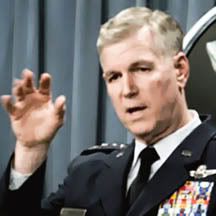
In September 2001 Air Force General Richard Myers was Vice-Chairman of the Joint Chiefs of Staff, scheduled on the 13th to be promoted and replace outgoing Chairman Henry Shelton. Myers was able to get a slight head start, taking over as acting JCS Chairman on the morning of September 11th as Shelton left on a trip to Europe on prearranged but unspecified business. [1] It was supposed to be a routine day, of course, but the nation's top military officer, and the optional number three link in the National Defense Chain of Command was filled at the last moment by Myers, who took the spot just as the day’s JCS/NORAD war games, and the 9/11 hijackings, began.
But he while he was, perhaps unwittingly, caught in a ready-made conspiracy theory crossfire, Myers was not in the thick of things during the battle of the World Trade Center or even the Pentagon strike. According to American Forces Press Service, Myers:
“was on Capitol Hill that morning in the offices of Georgia Sen. Max Cleland to discuss his confirmation hearing to become chairman. While in an outer office, he said, he saw a television report that a plane had hit the World Trade Center. “They thought it was a small plane or something like that,” Myers said. So the two men went ahead with the office call. Meanwhile, the second World Trade Center tower was hit by another jet. “Nobody informed us of that,” Myers said. “But when we came out, that was obvious. Then, right at that time, somebody said the Pentagon had been hit.” [2]
Myers’ recollection, then, was that his fifty-minute meeting with Cleland (apparently from about 8:50 to 9:40) just sort of eclipsed the whole attack for him. Are we to believe that no one would bother to interrupt the Acting JCS Chairman, perhaps legally required to coordinate the defense, for over a half an hour after the second plane hit? This was the point at which everybody else, even President Bush, realized we were under attack. It was bigger and uglier and closer to home than Pearl Harbor by far, and Myers says nobody pulled his head out of the sand for him at all, that he just stumbled into awareness after his meeting had run its course, at the moment the third plane hit.
Myers then drove across town to the NMCC beneath the wounded Pentagon, which he later described as “essentially my battle station when things are happening.” [3] Or in this case, as things just got done happening. The 9/11 Commission says he arrived and joined the conference in session just before 10:00. [4] The last plane, Flight 93, crashed at 10:06 and the attack was over.
Sources:
[1] Balz, Dan and Bob Woodward. “America's Chaotic Road to War: Bush's Global Strategy Began to Take Shape in First Frantic Hours After Attack.” Washington Post. January 27, 2002. Page A01. http://www.washingtonpost.com/ac2/wp-dyn/A42754-2002Jan26
[2] Rhem, Kathleen, Sgt. 1st Class. “Myers and Sept. 11: “We Hadn't Thought About This.”” American Forces Press Service. October 23, 2001 Accessed November 6, 2004 at: http://www.defenselink.mil/news/Oct2001/n10232001_200110236.html
[3] General Richard B. Myers, Senate Confirmation Hearing. Senate Armed Services Committee. September 13, 2001. Accessed August 5, 2005 at: http://www.attackonamerica.net/genrichardbmyerssenateconfirmationhearing9132001.htm
[4] 9/11 Commission Final Report. Page 38.
ACTING CHAIRMAN ACTING AS IF NOTHING'S AMISS
Adam Larson
Caustic Logic/They Let It Happen
January 10 2007
 |
But he while he was, perhaps unwittingly, caught in a ready-made conspiracy theory crossfire, Myers was not in the thick of things during the battle of the World Trade Center or even the Pentagon strike. According to American Forces Press Service, Myers:
“was on Capitol Hill that morning in the offices of Georgia Sen. Max Cleland to discuss his confirmation hearing to become chairman. While in an outer office, he said, he saw a television report that a plane had hit the World Trade Center. “They thought it was a small plane or something like that,” Myers said. So the two men went ahead with the office call. Meanwhile, the second World Trade Center tower was hit by another jet. “Nobody informed us of that,” Myers said. “But when we came out, that was obvious. Then, right at that time, somebody said the Pentagon had been hit.” [2]
Myers’ recollection, then, was that his fifty-minute meeting with Cleland (apparently from about 8:50 to 9:40) just sort of eclipsed the whole attack for him. Are we to believe that no one would bother to interrupt the Acting JCS Chairman, perhaps legally required to coordinate the defense, for over a half an hour after the second plane hit? This was the point at which everybody else, even President Bush, realized we were under attack. It was bigger and uglier and closer to home than Pearl Harbor by far, and Myers says nobody pulled his head out of the sand for him at all, that he just stumbled into awareness after his meeting had run its course, at the moment the third plane hit.
Myers then drove across town to the NMCC beneath the wounded Pentagon, which he later described as “essentially my battle station when things are happening.” [3] Or in this case, as things just got done happening. The 9/11 Commission says he arrived and joined the conference in session just before 10:00. [4] The last plane, Flight 93, crashed at 10:06 and the attack was over.
Sources:
[1] Balz, Dan and Bob Woodward. “America's Chaotic Road to War: Bush's Global Strategy Began to Take Shape in First Frantic Hours After Attack.” Washington Post. January 27, 2002. Page A01. http://www.washingtonpost.com/ac2/wp-dyn/A42754-2002Jan26
[2] Rhem, Kathleen, Sgt. 1st Class. “Myers and Sept. 11: “We Hadn't Thought About This.”” American Forces Press Service. October 23, 2001 Accessed November 6, 2004 at: http://www.defenselink.mil/news/Oct2001/n10232001_200110236.html
[3] General Richard B. Myers, Senate Confirmation Hearing. Senate Armed Services Committee. September 13, 2001. Accessed August 5, 2005 at: http://www.attackonamerica.net/genrichardbmyerssenateconfirmationhearing9132001.htm
[4] 9/11 Commission Final Report. Page 38.
Subscribe to:
Comments (Atom)


