Adam Larson / Caustic Logic
They Let It Happen
[undated]
Note [added 2/8/09] While I am leaving this post up as-is and FWIW, the core point of it - the apparent "muzzling" represented by the 2001 order - seems to have been debunked. See Mike W's 9/11 Myths page. What I'd previously read as an exception to new restrictions was actually THE change to a MORE restrictive previous order. Good thing I had already called it a red herring, rather than hanging any weight on the issue. So for the record - the June 1 change can have had no direct role in impeding the 9/11 defense, and so it's implementation is not direct evidence of any LIHOP thinking. Apologies also for the late update.
---
As indicated by the swift fighter response in the Payne Stewart case, the Chain of Command was not ordinarily needed to get escort fighters off the ground – this could all be done automatically and at intermediate levels. But more tightly controlled actions, like issuing an order for these fighters to shoot down a civilian aircraft, constituted an emergency and had to originate with the President and pass through every link in the chain of command to the responsible fighter pilots.
But these guidelines, in effect since 1986, oddly changed just three months before September 11, extending the need for approval yet further down. A Defense Department directive of June 1 2001 stated: “In the event of a hijacking, the NMCC will be notified by the most expeditious means by the FAA. The NMCC will, with the exception of immediate responses […] forward requests for DoD assistance to the Secretary of Defense for approval.” [1] Aviation Week backed this up: “On Sept. 11, the normal scramble-approval procedure was for an FAA official to contact the National Military Command Center (NMCC) and request Pentagon air support. Someone in the NMCC would call NORAD's command center and ask about availability of aircraft, then seek approval from the Defense Secretary--Donald H. Rumsfeld--to launch fighters.” [2] In other words, the automatic scrambling of fighters was no more – the Secretary of Defense now had to personally sign off before fighters could be sent up, and specifically in response to a hijacking. Michael Ruppert wrote that this change in procedures “demonstrated a willful intent to centralize decision-making away from field commanders prior to the attacks.” [3]
But the 9/11 Commission’s final report states in its blameless way: “As they existed on 9/11, the protocols for the FAA to obtain military assistance from NORAD required multiple levels of notification and approval at the highest levels of government […] The NMCC would then seek approval from the Office of the Secretary of Defense to provide military assistance […] The protocols did not contemplate an intercept […] On the morning of 9/11, the existing protocol was unsuited in every respect for what was about to happen.” [4] They do not mention how recently and intentionally it had become so unsuited.
Of course “immediate response” actions were allowed without Rumsfeld’s immediate permission, and it appears some thought the attacks fit this exception – neither the Otis nor the Langley fighters, the first wave of defense (scrampled 8:52 and 9:30), were scrambled with Rumsfeld’s permission. He claims he never even arrived at the NMCC until 10:30 am. According to the Commission, Major General Larry Arnold, commander of the Continental U.S. NORAD Region said to one of his subordinates “go ahead and scramble [the Otis fighters], and we’ll get authorities later.” So the fighters were sent up, if slowly and with great confusion, and Rumsfeld’s procedure change becomes a red herring, if a telling one.
Sources: [5] Ruppert, Micheal C. Crossing the Rubicon. Gabriola Island, BC, Canada. New Society Publishers. 2004. Page 316
[6] Scott, William B. “Exercise Jump-Starts Response to Attacks.” Aviation week’s Aviation Now. June 3, 2002. Accessed April 27, 2003 at: http://www.aviationnow.com/content/publication/awst/20020603/avi_stor.htm. (need subscription to read it now).
[7] See [5]. Ruppert. Page 337.
[8] National Commission on Terrorist Attacks upon the United States. 9/11 Commission Final Report. Page 17
Showing posts with label fighter scrambles. Show all posts
Showing posts with label fighter scrambles. Show all posts
Monday, February 9, 2009


Friday, October 12, 2007
THE CHAIN OF COMMAND ON 9/11 {masterlist}
 |
Tightly controlled actions, like issuing an order for fighter jets to shoot down a civilian aircraft, constituted an emergency and had to originate with the President and pass through every link in the chain to the responsible fighter pilots. As the 9/11 Commission explained, “prior to 9/11, it was understood that an order to shoot down a commercial aircraft would have to be issued by the National Command Authority (a phrase used to describe the president and secretary of defense).” [2]
This Chain of Command was not ordinarily needed to get escort fighters off the ground – this could all be done automatically and at intermediate levels, as indicated by the swift fighter response in the Payne Stewart case. These guidelines, in effect since 1986, oddly changed just three months before September 11, with Rumsfeld asserting the sole authority to allow fighters to take off at all. This is covered in more in detail in the post "Muzzling the Defense?"
The 9/11 Commission’s final report later stated in its blameless way: “As they existed on 9/11, the protocols for the FAA to obtain military assistance from NORAD required multiple levels of notification and approval at the highest levels of government […] The protocols did not contemplate an intercept […] On the morning of 9/11, the existing protocol was unsuited in every respect for what was about to happen.” It became even more unsuited in the days and hours and even minutes before the attacks, and on the morning of September 11th, strangely, the National Command Authority’s chain of command seemed to sprout new links, swap out old ones, and seemed to not be anchored down to anything. The following posts deal with the US leadership response and the flailings and failings of a Chain of broken links.
- President Bush: “There’s one Terrible Pilot:” The accidental President Stumbles into 9/11.
- Vice President Cheney, the Roadmap Swap, and the “Effort.” Clarifying the Record. Did Bush hand Cheney the joystick to control the attacks?
- Cheney and the Shoot-Down Order: Who issued the order and when? 9:45, 10:14, 10:18?
- Link #2 AWOL: Psychic Rumsfeld’s Wanderings
- Myers the stand-in: How he responds "when things are happening."
- First Day Jitters: Sliney, Leidig, Myers: Three Defense Links Swapped out at the last minute at Joint Chiefs of Staff (ACTING Chairman richard Myers, as of ?:00 am, 9/11) Benedict Sliney at FAA Operations Center (first day as of ?:00 am, 9/11) and Leidig at the NMCC (see chart below - standing in as of 8:30 am, 9/11, as per a request from the previous day). This is spooky.
In the end, what we got was a startlingly "unprepared" and disjointed command authority that ran something like this:

Monday, June 18, 2007
FAILED AIR DEFENSE {masterlist}
AN AERIAL BALLET OF PERFECTLY SYNCHRONIZED FAILURES (updated 2/5/07)
“Is this part of the exercise? Is this some kind of a screw-up?”
- Larry Arnold, NORAD Commander, upon hearing of the first hijack
“That was news to me. I thought we were still chasing American 11.”
- F-15 pilot “Duff” on hearing a second plane had hit the WTC
“Holy smoke, that’s why we’re here.”
- F-16 pilot “Lou” upon seeing smoke from the Pentagon
This post is to organize and link together all the related sub-posts on the ridiculously inadequate air defense during the 9/11 attack. The air-based wargames, which are referred to often in these posts, are covered seperately in the wargames masterlist. People still argue about whether our fighter defenses could have done anything if they had been better integrated. The answer depends on the presumptions one makes, but basically the answer is yes - there were procedures to defend the nation from roughly the 9/11 threat of suicide hijackings, but they have been magnified, obscured, and muddled by both sides in the post-9/11 debate. And they seem to have not been followed that morning.

This is a chart I made of the timeline of the attack and overall air defense during it - click the image to get a full-size, readable view (can also be saved and printed, 8.5 x 11").
> Status of air terror readiness as of 9/11: Could it be this bad on accident?
- Payne Stewart and Standard procedure: We had standard procedures for intercepting stray planes
- Rumors of a Stand-Down: Unprepared or Stood Down? (neither - this dichotomy is a false one).
- Muzzling the Defense: Rumsfeld's recent changes to fighter scramble procedures - ultimately a red herring?
- Warnings ignored?
- Fighter deployments decided on to defend the known primary zone of terrorism threats: notably inadequate.
- Commercial pilots' right to bear arms in the air rescinded in 2001? Post in the works...

> A Hobbled Defense in Action on 9/11
- Federal Attack Assistance? {masterlist}: The FAA's role in "dropping the ball" on 9/11, in several sub-posts: Sliney, the phantom Flight 11, the mistaken memo, etc...
- Phantom flights/radar inserts
- Radar blind spots
- Otis and Langley: Scrambling against the clock
- Heading and Speed: slowly away from the attacks
- Information shared with the defending fighter pilots: RIDICULOUSLY inadequate
> Permission to use deadly force to protect America: Negligently (?) denied
- No Such order recieved by the five defending pilots.
- Bush at Booker: Isolated accidents require no defensive orders, and Bush insisted on pretending it was an isolated accident until the last possible minute - and then still refused to issue the order for at least another hour. By the official story.
- Cheney and the Shoot-Down Order
“Is this part of the exercise? Is this some kind of a screw-up?”
- Larry Arnold, NORAD Commander, upon hearing of the first hijack
“That was news to me. I thought we were still chasing American 11.”
- F-15 pilot “Duff” on hearing a second plane had hit the WTC
“Holy smoke, that’s why we’re here.”
- F-16 pilot “Lou” upon seeing smoke from the Pentagon
This post is to organize and link together all the related sub-posts on the ridiculously inadequate air defense during the 9/11 attack. The air-based wargames, which are referred to often in these posts, are covered seperately in the wargames masterlist. People still argue about whether our fighter defenses could have done anything if they had been better integrated. The answer depends on the presumptions one makes, but basically the answer is yes - there were procedures to defend the nation from roughly the 9/11 threat of suicide hijackings, but they have been magnified, obscured, and muddled by both sides in the post-9/11 debate. And they seem to have not been followed that morning.
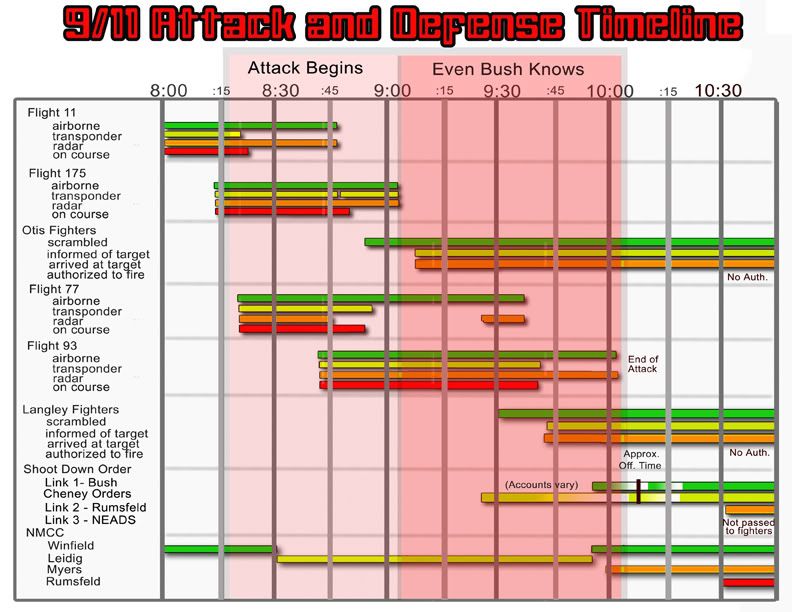
This is a chart I made of the timeline of the attack and overall air defense during it - click the image to get a full-size, readable view (can also be saved and printed, 8.5 x 11").
> Status of air terror readiness as of 9/11: Could it be this bad on accident?
- Payne Stewart and Standard procedure: We had standard procedures for intercepting stray planes
- Rumors of a Stand-Down: Unprepared or Stood Down? (neither - this dichotomy is a false one).
- Muzzling the Defense: Rumsfeld's recent changes to fighter scramble procedures - ultimately a red herring?
- Warnings ignored?
- Fighter deployments decided on to defend the known primary zone of terrorism threats: notably inadequate.
- Commercial pilots' right to bear arms in the air rescinded in 2001? Post in the works...
> A Hobbled Defense in Action on 9/11
- Federal Attack Assistance? {masterlist}: The FAA's role in "dropping the ball" on 9/11, in several sub-posts: Sliney, the phantom Flight 11, the mistaken memo, etc...
- Phantom flights/radar inserts
- Radar blind spots
- Otis and Langley: Scrambling against the clock
- Heading and Speed: slowly away from the attacks
- Information shared with the defending fighter pilots: RIDICULOUSLY inadequate
> Permission to use deadly force to protect America: Negligently (?) denied
- No Such order recieved by the five defending pilots.
- Bush at Booker: Isolated accidents require no defensive orders, and Bush insisted on pretending it was an isolated accident until the last possible minute - and then still refused to issue the order for at least another hour. By the official story.
- Cheney and the Shoot-Down Order
Thursday, February 1, 2007
MISSION CLARIFICATION
One of the Otis pilots said of the confusing orders he was given as he finally entered New York airspace “neither the civilian controller or the military controller knew what they wanted us to do." [1] They were fighters, made to get there quickly, identify their target, and fight. On 9/11 they were unable to do any of these. Langley pilot “Lou” called it the “smoke of war.” He noted to Jere Longman “no one knew exactly what was going on.” [2]
For a stunning example of what they were not told, Otis lead pilot Duff claims he and Nasty were never told about the history-making crash of American 11 six-minutes before they took off – and in fact believed they were still going to intercept it until they saw the smoke coming off Manhattan island, by then coming from both towers. Nearly a year after the attack, Duff still couldn’t recall hearing that the first plane had hit, as Aviation Week reported:
“‘Huntress,’ the NEADS weapons control center, had told Duffy his hijacked target was over John F. Kennedy International Airport. He hadn't heard about the United aircraft yet. “The second time I asked for bogey dope [location of AA11], Huntress told me the second aircraft had just hit the WTC. I was shocked… and I looked up to see the towers burning,” He asked for clarification of their mission, but was met with “considerable confusion.” [3]
He told the BBC that news of UA175’s impact was “obviously a shock to both Nasty and I, because we thought there was only one aircraft out there.” [4] According to the Cape Cod Times, “by the time (the pilots) heard a word about a second hijacked plane, United Airlines Flight 175, it had already smashed into the second tower before the horrified eyes of millions on TV.” [5] In other words, people watching CNN had more information than the defending pilots. This is an absolutely stunning failure that has not gotten the coverage it deserves.
The Langley pilots faced similar hurdles. First, as we’ve seen, they were given no information on the location and distance to their target and flew the wrong direction based on confused orders. After they were finally ordered to change directions and rocket north towards New York at 600 mph, they just happened to pass the Pentagon and saw the smoke billowing from it. Lou said “holy smoke, that’s why we’re here.” As Jere Longman explains it:
”The lead pilot was asked on his radio to verify whether the Pentagon was burning…. “That’s affirmative,” Honey replied.” But not having been informed of a plane in the area, the pilots presumed it was a truck bomb or something of that nature.” [6]
After confirming the attack there was complete, they were then sent to investigate. The 9/11 Commission noted that Honey told them “you couldn’t see any planes, and no one told us anything.” The Commission concluded “the pilots knew their mission was to divert aircraft, but did not know that the threat came from hijacked airliners.” [7]
“I looked up to see the towers burning." “Holy smoke, that’s why we’re here.” “The smoke of war.” In both cases, despite the most advanced tracking and communications technology in the world, the pilots of the first wave were informed of their failure to prevent the attacks via primitive smoke signal. Especially in a situation like 9/11, the old adage “knowledge is power” applies. With a track record like this of sharing knowledge with the defending pilots, the question arises – were these men meant to do anything other than provide a veneer of defense?
According the Jere Longman, the Langley pilots, in addition to never being informed of Flight 77, “did not even learn about Flight 93, or a plane crashing in Pennsylvania, until they returned to Langley.” This was around 2 pm. [8] Two hijacked planes had targeted Washington – AA77 and UA93. The Langley pilots were somehow never told of either. So why were they even in the air? According to the 9/11 Commission, they were chasing American 11 an hour after it crashed.
Sources:
[1] Dennehy, Kevin. “'I Thought It Was the Start of World War III'” The Cape Cod Times. August 21, 2002. http://www.poconorecord.com/report/911-2002/000232.htm
[2] Longman, Jere. "Among the Heroes." Page 222.
[3] Scott, William B. “Exercise Jump-Starts Response to Attacks.” Aviation week’s Aviation Now. June 3, 2002. Accessed April 27, 2003 at: http://www.aviationnow.com/content/publication/awst/20020603/avi_stor.htm
[4] BBC video. Clear the Skies. 2002.
[5] See [1]. Dennehy.
[6] See [2]. Page 76.
[7] 9/11 Commission Final Report. Page 45
[8] See [2]. Page 222.
For a stunning example of what they were not told, Otis lead pilot Duff claims he and Nasty were never told about the history-making crash of American 11 six-minutes before they took off – and in fact believed they were still going to intercept it until they saw the smoke coming off Manhattan island, by then coming from both towers. Nearly a year after the attack, Duff still couldn’t recall hearing that the first plane had hit, as Aviation Week reported:
“‘Huntress,’ the NEADS weapons control center, had told Duffy his hijacked target was over John F. Kennedy International Airport. He hadn't heard about the United aircraft yet. “The second time I asked for bogey dope [location of AA11], Huntress told me the second aircraft had just hit the WTC. I was shocked… and I looked up to see the towers burning,” He asked for clarification of their mission, but was met with “considerable confusion.” [3]
He told the BBC that news of UA175’s impact was “obviously a shock to both Nasty and I, because we thought there was only one aircraft out there.” [4] According to the Cape Cod Times, “by the time (the pilots) heard a word about a second hijacked plane, United Airlines Flight 175, it had already smashed into the second tower before the horrified eyes of millions on TV.” [5] In other words, people watching CNN had more information than the defending pilots. This is an absolutely stunning failure that has not gotten the coverage it deserves.
The Langley pilots faced similar hurdles. First, as we’ve seen, they were given no information on the location and distance to their target and flew the wrong direction based on confused orders. After they were finally ordered to change directions and rocket north towards New York at 600 mph, they just happened to pass the Pentagon and saw the smoke billowing from it. Lou said “holy smoke, that’s why we’re here.” As Jere Longman explains it:
”The lead pilot was asked on his radio to verify whether the Pentagon was burning…. “That’s affirmative,” Honey replied.” But not having been informed of a plane in the area, the pilots presumed it was a truck bomb or something of that nature.” [6]
After confirming the attack there was complete, they were then sent to investigate. The 9/11 Commission noted that Honey told them “you couldn’t see any planes, and no one told us anything.” The Commission concluded “the pilots knew their mission was to divert aircraft, but did not know that the threat came from hijacked airliners.” [7]
“I looked up to see the towers burning." “Holy smoke, that’s why we’re here.” “The smoke of war.” In both cases, despite the most advanced tracking and communications technology in the world, the pilots of the first wave were informed of their failure to prevent the attacks via primitive smoke signal. Especially in a situation like 9/11, the old adage “knowledge is power” applies. With a track record like this of sharing knowledge with the defending pilots, the question arises – were these men meant to do anything other than provide a veneer of defense?
According the Jere Longman, the Langley pilots, in addition to never being informed of Flight 77, “did not even learn about Flight 93, or a plane crashing in Pennsylvania, until they returned to Langley.” This was around 2 pm. [8] Two hijacked planes had targeted Washington – AA77 and UA93. The Langley pilots were somehow never told of either. So why were they even in the air? According to the 9/11 Commission, they were chasing American 11 an hour after it crashed.
Sources:
[1] Dennehy, Kevin. “'I Thought It Was the Start of World War III'” The Cape Cod Times. August 21, 2002. http://www.poconorecord.com/report/911-2002/000232.htm
[2] Longman, Jere. "Among the Heroes." Page 222.
[3] Scott, William B. “Exercise Jump-Starts Response to Attacks.” Aviation week’s Aviation Now. June 3, 2002. Accessed April 27, 2003 at: http://www.aviationnow.com/content/publication/awst/20020603/avi_stor.htm
[4] BBC video. Clear the Skies. 2002.
[5] See [1]. Dennehy.
[6] See [2]. Page 76.
[7] 9/11 Commission Final Report. Page 45
[8] See [2]. Page 222.
Saturday, January 13, 2007
HEADING AND SPEED
The five fighters were scrambled not toward their targets, already hundreds of miles distant. Instead, they were sent out over ocean on complicated and apparently confused flight plans. Otis pilot Duff said they departed on a “2-8-0 heading - basically towards New York City.” [1] But the route recorded by Paul Thompson in his Terror Timeline book shows a path south over the ocean instead of west-southwest along the coast.
The Langley fighters were sent due east, over the ocean, instead of north-northwest to the Pentagon. The 9/11 Commission concluded in their final report. “unlike a normal scramble order, this order did not include a distance to the target, or the target’s location.” [2] Confused orders and/or noise restrictions over land have also been cited as reasons for this easterly flight. In July 2004, Senator Mark Dayton (D-MN) issued a rare criticism of NORAD, whose massive failures “left this country defenseless during two of the worst hours in our history.” Dayton noted that when 77 hit, the Langley fighters were still far to the east, “farther [from the Pentagon] than they were before they took off.” [3]
The speed of the fighters once airborne is impossible to gauge unless we see the path actually flown in a given time. They were both sent the wrong direction at first, so we know they didn’t take the shortest, straight-line routes, and exact information on this is incomplete, perhaps top-secret. So a reconstruction seems incredibly tedious and uncertain.
But even in accounts that cite or imply actual speeds we see serious disagreements. Jere Longman, in his book Among the Heroes, explained that the Langley pilots “were sent east over the Atlantic Ocean, and then north up the coast They likely reached six hundred miles an hour in a couple of minutes.” [4] Major General Paul Weaver, director of the Air National Guard, said with no embarrassment that the pilots flew “like a scalded ape,” topping 500 mph. [5] Literally, there are cars that have driven faster than that.
An important factor to consider, as widely noted by defense apologists, is that supersonic flights on intercepts over the continental U.S. were banned by the Environmental Protection Agency, sonic booms being considered noise pollution. But an aircraft must travel at least 750 miles per hour for a sonic boom to be heard on the ground. So why were they reported to be going 150-250 mph slower than supersonic – even though they were over the ocean instead of over land? And why was this EPA regulation allowed to interfere with the defense on 9/11 instead of being ignored like all the others?
To hear the Otis pilots speak, the rule was ignored. Duff said clearly to the BBC “I was supersonic.” [6] Aviation week described Duff and Nasty as “flying supersonically.” On another occasion, he said “it just seemed wrong. I just wanted to get there. I was in full-blower all the way.” [7] An F-15, like the one he was flying, can travel a top (full-blower) speed of 1,875 mph (compared to a 767's top speed of just under 600mph). An F-16 (like those sent from Langley) can top out at 1500 mph. Clearly somebody isn’t telling the truth here.
Scrambled sooner, sent the right direction, and allowed to floor it, these fighters may well have made a difference – yet the prime worry, apparently, was avoiding an EPA speeding ticket.
Sources:
[1] “Clear the Skies: 9/11 Air Defense.” BBC Video. 2002. Produced and directed by Peter Molloy, Hosted by Gavin Hewitt.
[2] National Commission on Terrorist Attacks upon the United States. “The 9/11 Commission Report.” New York. W.W. Norton. 2004. Page 27.
[3] Ruppert, Michael C. “Crossing the Rubicon.” Gabriola Island, BC, CA. New Society Publishers. 2004. Page 440.
[4] Longman, Jere. “Among the Heroes: United Flight 93 and the Passengers and Crew who Fought Back.” New York. Harper Collins. 2002.
[5] Thompson, Paul. The Failure to Defend the Skies on 9/11.” Posting Date unlisted. Accessed November 29, 2004 at: http://www.cooperativeresearch.org/essay.jsp?article=essayairdefense
[6] See [1].
[7] Scott, William B. “Exercise Jump-Starts Response to Attacks.” Aviation week’s Aviation Now. June 3, 2002. Accessed April 27, 2003 at: http://www.aviationnow.com/content/publication/awst/20020603/avi_stor.htm
[8] Paul Thompson and the Center for Cooperative Research. “The Terror Timeline.” New York. Reagan Books. 2004. Page 380.
The Langley fighters were sent due east, over the ocean, instead of north-northwest to the Pentagon. The 9/11 Commission concluded in their final report. “unlike a normal scramble order, this order did not include a distance to the target, or the target’s location.” [2] Confused orders and/or noise restrictions over land have also been cited as reasons for this easterly flight. In July 2004, Senator Mark Dayton (D-MN) issued a rare criticism of NORAD, whose massive failures “left this country defenseless during two of the worst hours in our history.” Dayton noted that when 77 hit, the Langley fighters were still far to the east, “farther [from the Pentagon] than they were before they took off.” [3]
The speed of the fighters once airborne is impossible to gauge unless we see the path actually flown in a given time. They were both sent the wrong direction at first, so we know they didn’t take the shortest, straight-line routes, and exact information on this is incomplete, perhaps top-secret. So a reconstruction seems incredibly tedious and uncertain.
But even in accounts that cite or imply actual speeds we see serious disagreements. Jere Longman, in his book Among the Heroes, explained that the Langley pilots “were sent east over the Atlantic Ocean, and then north up the coast They likely reached six hundred miles an hour in a couple of minutes.” [4] Major General Paul Weaver, director of the Air National Guard, said with no embarrassment that the pilots flew “like a scalded ape,” topping 500 mph. [5] Literally, there are cars that have driven faster than that.
An important factor to consider, as widely noted by defense apologists, is that supersonic flights on intercepts over the continental U.S. were banned by the Environmental Protection Agency, sonic booms being considered noise pollution. But an aircraft must travel at least 750 miles per hour for a sonic boom to be heard on the ground. So why were they reported to be going 150-250 mph slower than supersonic – even though they were over the ocean instead of over land? And why was this EPA regulation allowed to interfere with the defense on 9/11 instead of being ignored like all the others?
To hear the Otis pilots speak, the rule was ignored. Duff said clearly to the BBC “I was supersonic.” [6] Aviation week described Duff and Nasty as “flying supersonically.” On another occasion, he said “it just seemed wrong. I just wanted to get there. I was in full-blower all the way.” [7] An F-15, like the one he was flying, can travel a top (full-blower) speed of 1,875 mph (compared to a 767's top speed of just under 600mph). An F-16 (like those sent from Langley) can top out at 1500 mph. Clearly somebody isn’t telling the truth here.
Scrambled sooner, sent the right direction, and allowed to floor it, these fighters may well have made a difference – yet the prime worry, apparently, was avoiding an EPA speeding ticket.
Sources:
[1] “Clear the Skies: 9/11 Air Defense.” BBC Video. 2002. Produced and directed by Peter Molloy, Hosted by Gavin Hewitt.
[2] National Commission on Terrorist Attacks upon the United States. “The 9/11 Commission Report.” New York. W.W. Norton. 2004. Page 27.
[3] Ruppert, Michael C. “Crossing the Rubicon.” Gabriola Island, BC, CA. New Society Publishers. 2004. Page 440.
[4] Longman, Jere. “Among the Heroes: United Flight 93 and the Passengers and Crew who Fought Back.” New York. Harper Collins. 2002.
[5] Thompson, Paul. The Failure to Defend the Skies on 9/11.” Posting Date unlisted. Accessed November 29, 2004 at: http://www.cooperativeresearch.org/essay.jsp?article=essayairdefense
[6] See [1].
[7] Scott, William B. “Exercise Jump-Starts Response to Attacks.” Aviation week’s Aviation Now. June 3, 2002. Accessed April 27, 2003 at: http://www.aviationnow.com/content/publication/awst/20020603/avi_stor.htm
[8] Paul Thompson and the Center for Cooperative Research. “The Terror Timeline.” New York. Reagan Books. 2004. Page 380.
Wednesday, December 27, 2006
Suited Up for Standard Procedure
To this day, opinions differ as to whether or not scrambling fighter jets was considered standard procedure in air emergencies at the time of the attacks or whether, as Popular Mechanics argued in March 2005, this was something rare and extraordinary. In their cover story “Debunking 9-11 Lies,” they tried to explain NORAD’s delays and failures by pointing out lamely that "in the decade before 9/11, NORAD intercepted only one civilian plane over North America: golfer Payne Stewart's Learjet, in October 1999 […] it took an F-16 1 hour and 22 minutes to reach the stricken jet. […] Prior to 9/11, all other NORAD interceptions were limited to offshore Air Defense Identification Zones (ADIZ). The ADIZ areas seem to be a sort of moat 'round the castle, where incoming international flights are made to identify themselves or risk being taken out. They run along the East and West Coasts and along the Mexican and Canadian borders. "Until 9/11 there was no domestic ADIZ," FAA spokesman Bill Schumann told the magazine. [1]
They would probably have liked to say there were no intercepts at all over continental airspace, but had to cede the one instance after it was pointed out in the factual record by 9-11 revisionists, an errant plane that crossed no borders or ocean shores and yet triggered a fighter escort. On October 26, 1999, famous pro Golfer Payne Stewart was flying in his private Learjet when the cabin lost pressure and killed all on board. The plane continued on autopilot across several states, trailed by fighter jets until it finally crashed in North Dakota. The shoot-down option was publicly addressed at the time: The Washington Post reported “Pentagon officials said they never considered shooting down the Learjet” because, according to a senior defense official, ‘the (FAA) said this thing was headed to a sparsely populated part of the country, so let it go.’” [2] Now, if it had been a hijacked 757 headed for New York after one plane had already crashed into the World Trade Center…
But was this the only fighter intercept ever ordered over the continental U.S.? If intercepts simply weren't done over the mainland, why was an exception made in this one case and this one case alone? Or did they mean this was the only intercept over America that made the news? According to an article in the Calgary Herald-Tribune from a month after the attack, fighter interception for stray aircraft actually was a weekly occurrence even before 9-11: “Today […] fighter jets are scrambled to babysit suspect aircraft or "unknowns" three or four times a day. Before Sept. 11, that happened twice a week. Last year, there were 425 unknowns -- pilots who didn't file or diverted from flight plans or used the wrong frequency. Jets were scrambled 129 times.” [3] Was every one of these 129 intercepts in the year 2000 over the ocean in ADIZ areas, with none over the continental U.S.? And in the nine years before that too, with the exception of one famous golfer?
Common sense and some evidence indicate otherwise. One of the fighter pilots that was scrambled on 9-11 said in a BBC documentary on his first notification of trouble “they said the Tower [was] calling and something about a hijacking. It was flight American 11, a 767, out of Boston going to California. At the time we ran in and got suited up… It's just peacetime. We're not thinking anything real bad is going to happen out there.” The narrator of the documentary adds “neither pilot at this time has any reason to believe that this is other than a routine exercise.” [4]
This was at some point before American 11 ended – we were still in pre-9-11 peace time, if the last minutes of it, and he knew to get suited up (that is, ready for takeoff) in response to the hijacking of a trans-continental flight. This sounds like a routine, standard procedure scramble and intended intercept over continental airspace to me. Perhaps the Payne Stewart case is not so anomalous after all.
Sources:
[1] Chertoff, Benjamin et al. “Debunking 9/11 Myths.” Popular Mechanics. March 2005.
[2] Walsh, Edward and William Claiborne. “Golfer Payne Stewart Dies in Jet Crash.” Washington Post. October 26, 1999. Page A1.
[3] Slobodian, Linda. “NORAD on Heightened Alert.” The Calgary Herald. October 13, 2001.
[4] BBC Video. Clear the Skies. First Aired September 2002.
They would probably have liked to say there were no intercepts at all over continental airspace, but had to cede the one instance after it was pointed out in the factual record by 9-11 revisionists, an errant plane that crossed no borders or ocean shores and yet triggered a fighter escort. On October 26, 1999, famous pro Golfer Payne Stewart was flying in his private Learjet when the cabin lost pressure and killed all on board. The plane continued on autopilot across several states, trailed by fighter jets until it finally crashed in North Dakota. The shoot-down option was publicly addressed at the time: The Washington Post reported “Pentagon officials said they never considered shooting down the Learjet” because, according to a senior defense official, ‘the (FAA) said this thing was headed to a sparsely populated part of the country, so let it go.’” [2] Now, if it had been a hijacked 757 headed for New York after one plane had already crashed into the World Trade Center…
But was this the only fighter intercept ever ordered over the continental U.S.? If intercepts simply weren't done over the mainland, why was an exception made in this one case and this one case alone? Or did they mean this was the only intercept over America that made the news? According to an article in the Calgary Herald-Tribune from a month after the attack, fighter interception for stray aircraft actually was a weekly occurrence even before 9-11: “Today […] fighter jets are scrambled to babysit suspect aircraft or "unknowns" three or four times a day. Before Sept. 11, that happened twice a week. Last year, there were 425 unknowns -- pilots who didn't file or diverted from flight plans or used the wrong frequency. Jets were scrambled 129 times.” [3] Was every one of these 129 intercepts in the year 2000 over the ocean in ADIZ areas, with none over the continental U.S.? And in the nine years before that too, with the exception of one famous golfer?
Common sense and some evidence indicate otherwise. One of the fighter pilots that was scrambled on 9-11 said in a BBC documentary on his first notification of trouble “they said the Tower [was] calling and something about a hijacking. It was flight American 11, a 767, out of Boston going to California. At the time we ran in and got suited up… It's just peacetime. We're not thinking anything real bad is going to happen out there.” The narrator of the documentary adds “neither pilot at this time has any reason to believe that this is other than a routine exercise.” [4]
This was at some point before American 11 ended – we were still in pre-9-11 peace time, if the last minutes of it, and he knew to get suited up (that is, ready for takeoff) in response to the hijacking of a trans-continental flight. This sounds like a routine, standard procedure scramble and intended intercept over continental airspace to me. Perhaps the Payne Stewart case is not so anomalous after all.
Sources:
[1] Chertoff, Benjamin et al. “Debunking 9/11 Myths.” Popular Mechanics. March 2005.
[2] Walsh, Edward and William Claiborne. “Golfer Payne Stewart Dies in Jet Crash.” Washington Post. October 26, 1999. Page A1.
[3] Slobodian, Linda. “NORAD on Heightened Alert.” The Calgary Herald. October 13, 2001.
[4] BBC Video. Clear the Skies. First Aired September 2002.
Monday, December 11, 2006
OTIS AND LANGLEY
SCRAMBLING AGAINST THE CLOCK
According to the official pre-2004 timeline supplied by NORAD, Boston flight control had waited twenty minutes after it decided Flight 11 was hijacked to alert them, at 8:40 am. This has been widely contested, with FAA insisting it had alerted NORAD much earlier. But anyway, at 8:46 NORAD issued the scramble order to Otis Air National Guard base in Cape Cod, Massachusetts – the same minute flight 11 slammed into the North Tower. The first two F-15 pilots, Lt. Col. Timothy Duffy (code-named “Duff”) and Major Daniel Nash (“Nasty”), were off the ground to intercept American 11 six minutes later, at 8:52.
This yielded a 39-minute loss-of-contact to takeoff time for Otis. This delay, coming after months of foreign and domestic warnings of possible hijackings, is 50%, longer than reaction in the totally unexpected Payne Stewart case two years earlier. These fighters were sent to intercept American 11 six minutes after it was obliterated in its impact with the WTC. [1] They finally arrived and established a combat air patrol over Manhattan at 9:25, 33 minutes after takeoff. [2]
At about this time, more jets were scrambled from Langley AFB in Virginia, the other ready pair in the northeast. NEADS called Langley at about 9:15 and asked national guardsman “Honey” urgently “how many planes can you send?” “We have two ready,” Honey replied. “That’s not what I asked,” came the curt reply. “How many can you get airborne?” “With me, three.’” Honey said.” [3] It’s not clear why there was an insistence on sending a third jet when standard procedure was to send a pair – I looked for clues in the 9/11 Commission’s final report, but it does not seem to mention the number of fighters sent from Langley. Since only two fighters were ready, prepping this third plane would set their schedule back. “Honey,” his partner “Lou,” and the unnamed third pilot took off at 9:30, just minutes before flight 77 reappeared on radar screens closing in on Washington. The CCR lists the pilots as pilots were Major Brad Derrig, Captain Craig Borgstrom, and Major Dean Eckmann, all from the North Dakota Air National Guard’s 119th Fighter Wing, then stationed at Langley, but I cannot find who was Honey, who was Lou, and ho as the third. The commission concluded they were not being sent to intercept American 77 closing in on Washington, but rather to New York to back up the Otis pilots. [4]
This was the entire first wave of national defense – five fighters, scrambled late from two bases far from the scene of the crime. More fighters would join them by about 10 am, but during the actual attack, the first wave was all there was. The following sections detail their mission, doomed to failure from the beginning.
(also linked on the air defense masterlist)
- Heading and Speed
- Information shared with the defending fighter pilots: RIDICULOUSLY inadequate
- No shoot-down order received.
Sources:
[1] North American Aerospace Defense Command News Release. “NORAD’s Response Times” September 18, 2001. Accessed May 7, 2003 at: http://www.unansweredquestions.org/timeline/2001/norad091801.html
[2] National Commission on Terrorist Attacks Upon the United States. The 9/11 Commission Report. Authorized First Edition. New York. W.W. Norton. 2004. Page 24.
[3] "9;30 am: Langley Fighters Take Off." http://www.cooperativeresearch.org/context.jsp?item=a930langleylaunch#a930langleylaunch
[4] Longman, Jere. Among the Heroes: United Flight 93 and the Passengers and Crew who Fought Back. New York. Harper Collins. 2002. Page 65.
According to the official pre-2004 timeline supplied by NORAD, Boston flight control had waited twenty minutes after it decided Flight 11 was hijacked to alert them, at 8:40 am. This has been widely contested, with FAA insisting it had alerted NORAD much earlier. But anyway, at 8:46 NORAD issued the scramble order to Otis Air National Guard base in Cape Cod, Massachusetts – the same minute flight 11 slammed into the North Tower. The first two F-15 pilots, Lt. Col. Timothy Duffy (code-named “Duff”) and Major Daniel Nash (“Nasty”), were off the ground to intercept American 11 six minutes later, at 8:52.
This yielded a 39-minute loss-of-contact to takeoff time for Otis. This delay, coming after months of foreign and domestic warnings of possible hijackings, is 50%, longer than reaction in the totally unexpected Payne Stewart case two years earlier. These fighters were sent to intercept American 11 six minutes after it was obliterated in its impact with the WTC. [1] They finally arrived and established a combat air patrol over Manhattan at 9:25, 33 minutes after takeoff. [2]
At about this time, more jets were scrambled from Langley AFB in Virginia, the other ready pair in the northeast. NEADS called Langley at about 9:15 and asked national guardsman “Honey” urgently “how many planes can you send?” “We have two ready,” Honey replied. “That’s not what I asked,” came the curt reply. “How many can you get airborne?” “With me, three.’” Honey said.” [3] It’s not clear why there was an insistence on sending a third jet when standard procedure was to send a pair – I looked for clues in the 9/11 Commission’s final report, but it does not seem to mention the number of fighters sent from Langley. Since only two fighters were ready, prepping this third plane would set their schedule back. “Honey,” his partner “Lou,” and the unnamed third pilot took off at 9:30, just minutes before flight 77 reappeared on radar screens closing in on Washington. The CCR lists the pilots as pilots were Major Brad Derrig, Captain Craig Borgstrom, and Major Dean Eckmann, all from the North Dakota Air National Guard’s 119th Fighter Wing, then stationed at Langley, but I cannot find who was Honey, who was Lou, and ho as the third. The commission concluded they were not being sent to intercept American 77 closing in on Washington, but rather to New York to back up the Otis pilots. [4]
This was the entire first wave of national defense – five fighters, scrambled late from two bases far from the scene of the crime. More fighters would join them by about 10 am, but during the actual attack, the first wave was all there was. The following sections detail their mission, doomed to failure from the beginning.
(also linked on the air defense masterlist)
- Heading and Speed
- Information shared with the defending fighter pilots: RIDICULOUSLY inadequate
- No shoot-down order received.
Sources:
[1] North American Aerospace Defense Command News Release. “NORAD’s Response Times” September 18, 2001. Accessed May 7, 2003 at: http://www.unansweredquestions.org/timeline/2001/norad091801.html
[2] National Commission on Terrorist Attacks Upon the United States. The 9/11 Commission Report. Authorized First Edition. New York. W.W. Norton. 2004. Page 24.
[3] "9;30 am: Langley Fighters Take Off." http://www.cooperativeresearch.org/context.jsp?item=a930langleylaunch#a930langleylaunch
[4] Longman, Jere. Among the Heroes: United Flight 93 and the Passengers and Crew who Fought Back. New York. Harper Collins. 2002. Page 65.
Tuesday, November 28, 2006
STAND-DOWN: DE JURE OR DE FACTO?
September 13, 2001: The nation is still staggering, in deep shock over the most devastating act of terrorism in American history. With the body count still not finalized but sitting near 6,000 (well-down from initial estimates of 20,000), General Richard B. Myers, Vice-Chairman of the Joint Chiefs of Staff (JCS), sits under oath in front of the Senate Armed Services Committee. This is his confirmation hearing, scheduled weeks before, to be promoted to the post of JCS Chairman, the highest U.S. military post. It was surely a bittersweet event for him. He had already started his tenure as acting JCS Chairman two days earlier - on the morning of September 11th. He had been standing in for his superior Henry Shelton, who had just that morning left on a trip to Europe on prearranged but unspecified business. [1] In the hearing, this curious coincidence was ignored, but Chairman Carl Levin (D-MI) asked the candidate about the failed military response during the attack, with which Myers was closely involved.
Levin: “Was the defense department asked to take action against any specific aircraft? […] And did you take action against – for instance, there has been statements that the aircraft that crashed in Pennsylvania was shot down. Those stories continue to exist.”
Myers: “Mr. Chairman, the armed forces did not shoot down any aircraft. When it became clear what the threat was, we did scramble fighter aircraft, AWACS, radar aircraft and tanker aircraft to begin to establish orbits in case other aircraft showed up in the FAA system that were hijacked. But we never actually had to use force.”
Levin: “Was that order that you just described given before or after the Pentagon was struck? Do you know?”
Myers: “That order, to the best of my knowledge, was after the Pentagon was struck.” [2]
With his first-hand knowledge of what happened only two days earlier, he maintained that his military did not scramble any fighters in response until after the Pentagon was hit by the third hijacked plane of the morning at 9:37. This was thirty-five minutes – at least - after a second hijacked airliner plowed into the World Trade Center at 9:03, clarifying to everyone we were at war – and quickly losing. How could the mightiest Air Force on Earth be so slow responding to such an urgent emergency?
This was not merely Myers’ confused recollection; the next day, Major Mike Snyder, a spokesman for the North American Aerospace Defense Command (NORAD), backed him up on this point. According to the Boston Globe: “[Snyder] said the fighters were not scrambled for more than an hour after the first hijacking was reported, by which time the three buildings were struck […] Never before had a hijacked airliner been steered into a skyscraper, Snyder noted, in trying to explain the lack of immediate response.” [3]
So on September 14, that was the official story, confirmed by both Myers and Snyder, by both the JCS and NORAD, and generally taken as fact. Even long after this official story had changed, then-Mayor of New York Rudy Giuliani would confirm this original assessment. He told the 9/11 Commission in May 2004 that he was told he just minutes before the first World Trade Tower collapsed at 9:58 that fighters had just been scrambled to protect New York “twelve minutes ago.” [4] By this account, the jets were airborne at about 9:46, exactly an hour after the first attack in New York.
It became clear with a CBS News broadcast that very night that this was actually not the case, that two fighter pilots had been sent at 8:52 from Massachusetts, and soon we had confirmation of another pair sent from Langley AFB in Virginia at 9:30. So why the early confusion?
I don't know the reason for this incongruity, but I do know the effects. On September 11, NORAD knew as of 8:40 (by their own account) that American 11 was (possibly) hijacked and headed to New York. Three minutes later, they learned a second airliner, United 175, was also (possibly) hijacked. As of 8:46, when flight 11 hit the Word Trade Center, they knew what kind of (possible) hijackings these were – just as UA175 changed course and headed for New York itself. Fighter interception should have been a no-brainer at this point, and authorization to shoot to kill should have been sought swiftly to defend future targets. Yet fifty-one minutes later, the new JCS Chairman tells us under oath, NORAD hadn’t got a single fighter off the ground? Honestly, that doesn’t even make sense. It looks like a stand-down.
Rumors began to spread of just this possibility, and persisted well past the reports on 9/14 and after that fighters were scrambled. In September 2003 Michael Meacher, former British Environment Minister, wrote an article for the Manchester Guardian called “This War on Terrorism is Bogus.” He pointed out that no fighters were scrambled from the nation’s premier Andrews Air Force Base, only ten miles from the Pentagon, during the course of the attack. Meacher wondered “was this inaction simply the result of key people disregarding, or being ignorant of, the evidence? Or could US air security operations have been deliberately stood down on September 11? If so, why, and on whose authority?” [5]
It’s a good question; Andrews is the nation’s premiere Air Force base, home of Air Force One, and touchdown point for world leaders visiting the U.S. It is in many ways the central staging ground for the most elaborate airspace defense in the world – yet no fighters were sent from there until well after the attack was over with. Mark R. Elsis of StandDown.net. put it “there is only one explanation. Our Air Force was ordered to stand down on 9/11.” [6]
I had always found a direct stand-down order a possibility, but too simple of one – did Meacher and Elsis mean an indirect, de facto stand-down or a direct, de jure one? A formal stand-down order is an order, official, total, and enforced as such. Are we really to believe that of the hundreds of pilots ready to take off and help in such a crisis, all told by their superiors to stay on the ground, none would be angry and courageous enough to speak up? Even I, in my profound cynicism, find this hard to swallow. A de jure stand-down seems unlikely to me, and a simplistic argument that looks for an easily identifiable smoking gun of complicity.
Mike Ruppert took this line as well in mid-2004: “There never was a stand down order issued. That would have been way too incriminating and risky a piece of evidence. And it also might have been ignored by eager fighter pilots who had trained their whole lives to respond to a hostile aircraft killing Americans. There are several statements that the "new" NORAD procedures transferring scramble authority to Rumsfeld on June 1, 2001 were ignored by several NORAD commanders on 9/11 including General Larry Arnold. That's exactly what I would have expected.” [7]
However, a close look at the facts reveals an air defense system not just broken but peculiarly broken on that “fateful” morning, with the same net result as a de facto stand-down order. That is, stand down or no, the defense was as ineffective as if there had been, and it hardly seems any less purposeful than Meacher or Elsis suggests.
Sources:
[1] Balz, Dan and Bob Woodward. “America's Chaotic Road to War: Bush's Global Strategy Began to Take Shape in First Frantic Hours After Attack.” Washington Post. January 27, 2002. Page A01. Accessed November 6, 2004 at: http://www.washingtonpost.com/ac2/wp-dyn/A42754-2002Jan26
[2] General Richard B. Myers, Senate Confirmation Hearing. Senate Armed Services Committee. September 13, 2001. Accessed August 5, 2005 at: http://www.attackonamerica.net/genrichardbmyerssenateconfirmationhearing9132001.htm
[3] Johnson, Glen. "Facing Terror Attack's Aftermath: Otis Fighter Jets Scrambled Too Late to Halt The Attacks" The Boston Globe. September 15, 2001 Third Edition Page A1. Accessed at: http://emperors-clothes.com/9-11backups/bg915.htm
[4] Thompson, Paul and the Center for Cooperative Research. The Terror Timeline: Year by Year, Day by Day, Minute by Minute. New York. Regan books. 2004. Page 439
[5] Ruppert, Michael C. Crossing the Rubicon: The Decline of the American Empire at the End of the Age of Oil. Gabriola Island, BC, Canada. New Society Publishers 2004 P. 309
[6] Chertoff, Benjamin et al. “Debunking 9/11 Myths.” Popular Mechanics, March 2005. http://www.popularmechanics.com/technology/military_law/1227842.html?page=3
[7]Ruppert, Michael C. http://www.fromthewilderness.com/free/ww3/060704_tripod_fema.html
Levin: “Was the defense department asked to take action against any specific aircraft? […] And did you take action against – for instance, there has been statements that the aircraft that crashed in Pennsylvania was shot down. Those stories continue to exist.”
Myers: “Mr. Chairman, the armed forces did not shoot down any aircraft. When it became clear what the threat was, we did scramble fighter aircraft, AWACS, radar aircraft and tanker aircraft to begin to establish orbits in case other aircraft showed up in the FAA system that were hijacked. But we never actually had to use force.”
Levin: “Was that order that you just described given before or after the Pentagon was struck? Do you know?”
Myers: “That order, to the best of my knowledge, was after the Pentagon was struck.” [2]
With his first-hand knowledge of what happened only two days earlier, he maintained that his military did not scramble any fighters in response until after the Pentagon was hit by the third hijacked plane of the morning at 9:37. This was thirty-five minutes – at least - after a second hijacked airliner plowed into the World Trade Center at 9:03, clarifying to everyone we were at war – and quickly losing. How could the mightiest Air Force on Earth be so slow responding to such an urgent emergency?
This was not merely Myers’ confused recollection; the next day, Major Mike Snyder, a spokesman for the North American Aerospace Defense Command (NORAD), backed him up on this point. According to the Boston Globe: “[Snyder] said the fighters were not scrambled for more than an hour after the first hijacking was reported, by which time the three buildings were struck […] Never before had a hijacked airliner been steered into a skyscraper, Snyder noted, in trying to explain the lack of immediate response.” [3]
So on September 14, that was the official story, confirmed by both Myers and Snyder, by both the JCS and NORAD, and generally taken as fact. Even long after this official story had changed, then-Mayor of New York Rudy Giuliani would confirm this original assessment. He told the 9/11 Commission in May 2004 that he was told he just minutes before the first World Trade Tower collapsed at 9:58 that fighters had just been scrambled to protect New York “twelve minutes ago.” [4] By this account, the jets were airborne at about 9:46, exactly an hour after the first attack in New York.
It became clear with a CBS News broadcast that very night that this was actually not the case, that two fighter pilots had been sent at 8:52 from Massachusetts, and soon we had confirmation of another pair sent from Langley AFB in Virginia at 9:30. So why the early confusion?
I don't know the reason for this incongruity, but I do know the effects. On September 11, NORAD knew as of 8:40 (by their own account) that American 11 was (possibly) hijacked and headed to New York. Three minutes later, they learned a second airliner, United 175, was also (possibly) hijacked. As of 8:46, when flight 11 hit the Word Trade Center, they knew what kind of (possible) hijackings these were – just as UA175 changed course and headed for New York itself. Fighter interception should have been a no-brainer at this point, and authorization to shoot to kill should have been sought swiftly to defend future targets. Yet fifty-one minutes later, the new JCS Chairman tells us under oath, NORAD hadn’t got a single fighter off the ground? Honestly, that doesn’t even make sense. It looks like a stand-down.
Rumors began to spread of just this possibility, and persisted well past the reports on 9/14 and after that fighters were scrambled. In September 2003 Michael Meacher, former British Environment Minister, wrote an article for the Manchester Guardian called “This War on Terrorism is Bogus.” He pointed out that no fighters were scrambled from the nation’s premier Andrews Air Force Base, only ten miles from the Pentagon, during the course of the attack. Meacher wondered “was this inaction simply the result of key people disregarding, or being ignorant of, the evidence? Or could US air security operations have been deliberately stood down on September 11? If so, why, and on whose authority?” [5]
It’s a good question; Andrews is the nation’s premiere Air Force base, home of Air Force One, and touchdown point for world leaders visiting the U.S. It is in many ways the central staging ground for the most elaborate airspace defense in the world – yet no fighters were sent from there until well after the attack was over with. Mark R. Elsis of StandDown.net. put it “there is only one explanation. Our Air Force was ordered to stand down on 9/11.” [6]
I had always found a direct stand-down order a possibility, but too simple of one – did Meacher and Elsis mean an indirect, de facto stand-down or a direct, de jure one? A formal stand-down order is an order, official, total, and enforced as such. Are we really to believe that of the hundreds of pilots ready to take off and help in such a crisis, all told by their superiors to stay on the ground, none would be angry and courageous enough to speak up? Even I, in my profound cynicism, find this hard to swallow. A de jure stand-down seems unlikely to me, and a simplistic argument that looks for an easily identifiable smoking gun of complicity.
Mike Ruppert took this line as well in mid-2004: “There never was a stand down order issued. That would have been way too incriminating and risky a piece of evidence. And it also might have been ignored by eager fighter pilots who had trained their whole lives to respond to a hostile aircraft killing Americans. There are several statements that the "new" NORAD procedures transferring scramble authority to Rumsfeld on June 1, 2001 were ignored by several NORAD commanders on 9/11 including General Larry Arnold. That's exactly what I would have expected.” [7]
However, a close look at the facts reveals an air defense system not just broken but peculiarly broken on that “fateful” morning, with the same net result as a de facto stand-down order. That is, stand down or no, the defense was as ineffective as if there had been, and it hardly seems any less purposeful than Meacher or Elsis suggests.
Sources:
[1] Balz, Dan and Bob Woodward. “America's Chaotic Road to War: Bush's Global Strategy Began to Take Shape in First Frantic Hours After Attack.” Washington Post. January 27, 2002. Page A01. Accessed November 6, 2004 at: http://www.washingtonpost.com/ac2/wp-dyn/A42754-2002Jan26
[2] General Richard B. Myers, Senate Confirmation Hearing. Senate Armed Services Committee. September 13, 2001. Accessed August 5, 2005 at: http://www.attackonamerica.net/genrichardbmyerssenateconfirmationhearing9132001.htm
[3] Johnson, Glen. "Facing Terror Attack's Aftermath: Otis Fighter Jets Scrambled Too Late to Halt The Attacks" The Boston Globe. September 15, 2001 Third Edition Page A1. Accessed at: http://emperors-clothes.com/9-11backups/bg915.htm
[4] Thompson, Paul and the Center for Cooperative Research. The Terror Timeline: Year by Year, Day by Day, Minute by Minute. New York. Regan books. 2004. Page 439
[5] Ruppert, Michael C. Crossing the Rubicon: The Decline of the American Empire at the End of the Age of Oil. Gabriola Island, BC, Canada. New Society Publishers 2004 P. 309
[6] Chertoff, Benjamin et al. “Debunking 9/11 Myths.” Popular Mechanics, March 2005. http://www.popularmechanics.com/technology/military_law/1227842.html?page=3
[7]Ruppert, Michael C. http://www.fromthewilderness.com/free/ww3/060704_tripod_fema.html
Sunday, November 26, 2006
A Yawning Gap
On the evening of September 14 the first story of the Air Force response to the three-day old attack was aired on CBS News.- The two F-15 pilots were scrambled from Otis AFB on Cape Cod, Massachusetts at 8:52, just after the first plane's impact but well before the second. Despite what officials had thus far said, it seemed fighters did get airborne during the attack. This made us feel a little better.
After this news was reported, the official stance changed. On the 18th, NORAD published their final initial timeline, including the Otis scramble time as 8:52, and an additional scramble of fighters from Langley Air Force Base at 9:30, ceding two scrambles before the Pentagon was hit. This timeline changed yet again in 2004 as the 9/11 Commission released its findings. Most of the facts that follow are from this newer version of events (the scrambles just mentioned are agreed on in both versions).
At the time of the attacks, only fourteen fighters were routinely kept on ready and alert status across the US mainland. These were deployed and scrambled in pairs, so these fighters represented only seven actual deployments. Nearly all reported pre-9/11 threats of terrorist attacks, some involving hijackings, focused on New York or Washington D.C. Yet on that morning, only two of these seven deployments were in the Northeast sector, thick with air traffic (about 50% of the national total) and with threats against it (nearly all threats targeted New York or Washington). The BBC quoted Colonel Robert Marr, Commander of the North East Air Defense Sector (NEADS), as saying “I had determined, of course, that with only four aircraft we cannot defend the whole north eastern United States.” Worse, these deployments were on the northern and southern fringes of the area of vulnerability, in each case about 150 miles away from the nearest targeted site. One newspaper wondered why NORAD had left “what seems to be a yawning gap in the midsection of its air defenses on the East Coast – a gap with New York City at the center.”
> DEPLOYMENT KEY:
(Graphic by the Author, based on post-9/11 research - exact basing at the time of the attack is not clear, but clearly seems inadequate for what unfolded that day, revealing, at best, poor planning of the air defenses in a time of heightened alert)
1) Hancock Field Air National Guard Base (ANGB), Syracuse, NY. 174th Fighter Wing. Very close to Rome, NY HQ of NEADS.
2) Barnes ANGB, MA. 104th Fighter Wing
3) Bradley ANG base, CT. 103rd Fighter Wing.
4) Otis AFB, Falmouth, MA. Postings and status unclear. Scrambled two F-16s at 8:52.
5) Willow Grove, PA. 11th Fighter Wing.
6) Atlantic City ANGB, NJ. 177th Fighter Wing. Atlantic City had two F-16s In the air on 9/11 for a bombing exercise near the city. Boston flight controllers tried to contact the base at 8:34, but the phone just rang. They weren’t on “ready” status as they had been in previous years. This fighter pair was finally sent to Washington after 10:00.
7) Andrews AFB - it's actually closer than it looks here, only 10 miles from the Pentagon - home of the 113th wing DC Air National Guard and the Air National Guard Readiness Center. They did not get fighter off the ground on 9/11 until 10:42, and these were sent up without missiles. The pair sent had been in the air on a training mission in South Carolina as the attack began.
8) Langley AFB, VA. 10th Intelligence Squadron, Air Force Doctrine Center, Air Combat Command, 1st Fighter Wing. Scrambled two F-15s and an unidentified third plane at 9:30.
After this news was reported, the official stance changed. On the 18th, NORAD published their final initial timeline, including the Otis scramble time as 8:52, and an additional scramble of fighters from Langley Air Force Base at 9:30, ceding two scrambles before the Pentagon was hit. This timeline changed yet again in 2004 as the 9/11 Commission released its findings. Most of the facts that follow are from this newer version of events (the scrambles just mentioned are agreed on in both versions).
At the time of the attacks, only fourteen fighters were routinely kept on ready and alert status across the US mainland. These were deployed and scrambled in pairs, so these fighters represented only seven actual deployments. Nearly all reported pre-9/11 threats of terrorist attacks, some involving hijackings, focused on New York or Washington D.C. Yet on that morning, only two of these seven deployments were in the Northeast sector, thick with air traffic (about 50% of the national total) and with threats against it (nearly all threats targeted New York or Washington). The BBC quoted Colonel Robert Marr, Commander of the North East Air Defense Sector (NEADS), as saying “I had determined, of course, that with only four aircraft we cannot defend the whole north eastern United States.” Worse, these deployments were on the northern and southern fringes of the area of vulnerability, in each case about 150 miles away from the nearest targeted site. One newspaper wondered why NORAD had left “what seems to be a yawning gap in the midsection of its air defenses on the East Coast – a gap with New York City at the center.”
 |
> DEPLOYMENT KEY:
(Graphic by the Author, based on post-9/11 research - exact basing at the time of the attack is not clear, but clearly seems inadequate for what unfolded that day, revealing, at best, poor planning of the air defenses in a time of heightened alert)
1) Hancock Field Air National Guard Base (ANGB), Syracuse, NY. 174th Fighter Wing. Very close to Rome, NY HQ of NEADS.
2) Barnes ANGB, MA. 104th Fighter Wing
3) Bradley ANG base, CT. 103rd Fighter Wing.
4) Otis AFB, Falmouth, MA. Postings and status unclear. Scrambled two F-16s at 8:52.
5) Willow Grove, PA. 11th Fighter Wing.
6) Atlantic City ANGB, NJ. 177th Fighter Wing. Atlantic City had two F-16s In the air on 9/11 for a bombing exercise near the city. Boston flight controllers tried to contact the base at 8:34, but the phone just rang. They weren’t on “ready” status as they had been in previous years. This fighter pair was finally sent to Washington after 10:00.
7) Andrews AFB - it's actually closer than it looks here, only 10 miles from the Pentagon - home of the 113th wing DC Air National Guard and the Air National Guard Readiness Center. They did not get fighter off the ground on 9/11 until 10:42, and these were sent up without missiles. The pair sent had been in the air on a training mission in South Carolina as the attack began.
8) Langley AFB, VA. 10th Intelligence Squadron, Air Force Doctrine Center, Air Combat Command, 1st Fighter Wing. Scrambled two F-15s and an unidentified third plane at 9:30.
Subscribe to:
Posts (Atom)


